

P-20 Network Meeting Explores Educator Shortage and Educator Retention
The Illinois P-20 Network hosted its Fall 2022 Meeting at NIU Naperville on Thursday, October 27, with a return to an in-person meeting for the first time since October 2019. Nearly 100 educational leaders from across Illinois were in attendance. Approximately 40% of attendees were school district leaders. 40% of attendees were postsecondary leaders, and the remaining 20% were leaders in state agencies and other professional and advocacy organizations.
The meeting began with NIU President Lisa Freeman, who shared the very personal story of her mother as a career-changing teacher in the 1960s and the impact she had on her students and their families, and Dean of the NIU College of Education Dr. Laurie Elish-Piper, who explored all the ways that educational institutions can engage and support teachers through a career pipeline from their early career exploration as middle school students through their in-service teaching and even how they can continue to support students and schools in retirement.
A series of Ignite presentations followed. Each of these presenters specifically addressed key, unique aspects of the educator shortage and/or solutions to it. The presentations included:
- Alyson Sprehe, a middle school teacher from Community Consolidated School District 21, who described how moving across all three middle schools and teaching at all three middle level grades over the course of her 25-year career has helped keep her fresh and innovating.
- Dr. Laura Hedin, department chair of Special and Early Education in the NIU College of Education, who spoke about NIU’s LEAP program, which is currently in place in both Rockford Public School District 205 and in School District U-46 and which supports practicing paraprofessionals with earning their licensure as a special education teacher while working on an accelerated timeframe.
- Bob Cofield, the director of school partnerships at Waubonsee Community College, who shared about the work that has taken place between Waubonsee, East Aurora, West Aurora, and NIU to create a modified 1+1+2 program that ensures students’ dual credit experiences in twelfth grade transfer into their degree program as education majors while also giving them a strong understanding of their work as future teachers.
- Arturo Senteno, principal at West Leyden High School, whose doctoral research has focused on the keys to teacher retention specifically for Latinx teachers. As part of this presentation Arturo provided specific recommendations for teachers and principals that should broadly help ensure high levels of performance and job satisfaction and that lead to strong retention among Latinx educators.
- Dr. Teresa Lance, assistant superintendent of equity and innovation in School District U-46, communicated six key themes for supporting teachers from diverse backgrounds in helping to lead transformative change in schools and districts. As Dr. Lance stressed, while these themes and their corresponding actions are critical for retaining teachers of color, these are also practices that all educators should employ each day.
Attendees then selected one of the following break-out sessions, in which they explored solutions to different aspects of the educator shortage and engaged in dialogue about those potential solutions. The break-out sessions were:
- Induction and Mentoring, which was led by Dr. Jodi Megerle, superintendent, and Kristy Seifert, assistant superintendent for teaching and learning, in River Trails School District 26.
- Diversification of the Teacher Workforce, which was led by Dr. Eric Junco, director of equity for the NIU College of Education.
- Supporting Dual Credit Teacher Credentialing, which was led by Anne Brennan, assistant vice president for academic affairs at Oakton Community College and by Dr. Patrick McGill, director for teaching and learning, curriculum and pathways in Glenbard School District 87.
- Avoiding Chutes out of the Profession; Building Teacher Career Ladders, led by Dr. Jason Klein, senior director of education partnerships and learning solutions at Northern Illinois University.
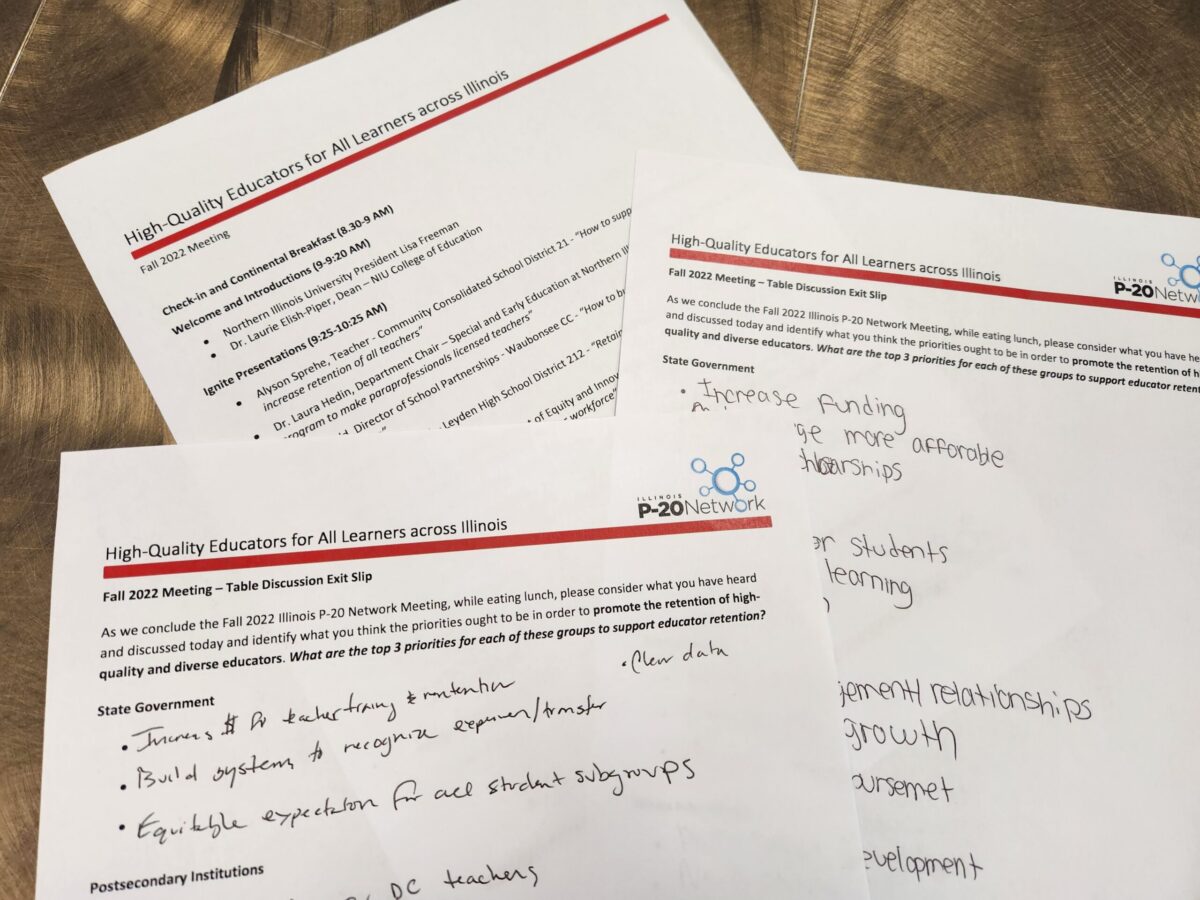
Finally, everyone came back together for a working lunch that featured table discussions about everything that people had heard and in which the tables identified the top three priorities to support educator retention for each of the following groups in Illinois: state government, postsecondary institutions, school districts, and the Illinois P-20 Network. At this time, the Illinois P-20 Network leadership team is organizing and analyzing the data from this activity, and the team will be publishing an action plan in an upcoming newsletter that will align to our Illinois P-20 Network Areas of Focus and lead to an updated mission statement for the Illinois P-20 Network.
