

Research Webinar Series
We’re excited to announce the P-20 Network Research Series, which will feature free webinars on topics related to the P-20 Network Areas of Focus and of interest to individuals and organizations across the Illinois P-20 Network. While we will be sharing more webinars over the next couple of weeks, the first webinars are on the schedule.
- Friday, April 17 – 1 PM – Student Motivation and CTE Course Selection – Joe Bruno – Register
- Friday, April 24 – 9 AM – Career readiness implementation in school districts across Illinois – Amanda Pelsor – Register
More information about upcoming webinars will be shared on this page on the Illinois P-20 Network website, the Illinois P-20 Network LinkedIn feed, and upcoming Newsletters.
March 2026In the Workplace Aurora
Improving economic development is vital to all communities and central to long-term success with Aurora’s efforts to ensure economic prosperity across such a large, diverse community. To further such efforts, Illinois has enacted policies requiring school districts to implement work-based learning. Work-Based Learning requires committed, long-term partnerships with employers across all Career Pathways, and building these relationships and engaging employers in the possibilities and benefits of work-based learning takes significant time.
In the Workplace Aurora will jump start these efforts by leveraging existing community-based, business-focused organizations to bring employers and school districts together for training led by NIU’s Illinois P-20 Network, a statewide leader in work-based learning and career readiness. The In the Workplace Auora effort is supported by the generosity of the Dunham Foundation.
East Aurora School District 131, West Aurora School District 129, and the VALEES EFE leadership have been in close collaboration with the Illinois P-20 Network to implement this exciting project, which seeks to engage employers in the benefits and mechanics of the work-based learning continuum. Employer engagement events are now scheduled, and employers from throughout the Aurora region are encouraged to attend one of the three sessions (with a meal included) to learn more about both why they would want to collaborate with the school districts and how to collaborate on bringing students in to the workplace to apply the skills that they are learning at school and to learn about careers.
Join us at any of the following free sessions:
April 16 – 11.30 AM – Aurora Economic Alliance Office (map) Lunch included at no cost to attendees
April 27 – 11.30 AM – East Aurora School District 131 District Office (map) Lunch included at no cost to attendees
June 11 – 8.00 AM – West Aurora Weisner Center (map) Breakfast included at no cost to attendees
February 2026Webinar – Dual Credit and Weighted Grades v2
During the latter part of the fall and early this winter, we shared a survey statewide regarding current high school weighted grade practices with regards to dual credit coursework. The survey data has been analyzed, and we are excited to host a webinar in collaboration with ILACEP to share these results. The webinar will be held on Tuesday, February 17 at 1 PM. The webinar is free, and you are encouraged to share with colleagues!
January 2026New Dual Credit Survey – Dual Credit & Weighted Grades – v.2025
Please take just a few minutes to help provide updated information to Illinois’ statewide dual credit community! And, please share this survey with colleagues across your region and across Illinois!
During the 2021-2022 school year, the Illinois P-20 Network conducted a short survey on Dual Credit and Weighted Grades. The results of this survey were shared with districts across Illinois through an ILACEP webinar and slide deck. Read more about the 2021-2022 survey on the Illinois P-20 Network website. Since March 2022, the Illinois P-20 Network is aware of many school districts who have reviewed and refined their practices, and now, we are launching this new survey to better understand the current state of grade weighting for dual credit courses across Illinois. (The request for this updated survey came from our regional dual credit work in one particular region, and coupled with the movement on this topic that we know has taken place in some of their neighboring regions over the past three years, the time seemed right to undertake this study!)
This new survey is a confidential survey (your school district will not be disclosed). Please take this very quick and short, but very important, survey, and please share it with others!
October 2025ECN – Big Hollow Builds Success with Student-Centered Coaching
Instructional Coach Marielle Brown of Big Hollow School District 38 attended our ECN student-centered coaching training with Diane Sweeney two years ago. Since then, the district has added three additional coaches, and teachers’ desire for coaching is off the charts.
ECN’s Alison Gordon asked Marielle why she recommends student-centered coaching and how to get the most out of Diane’s training sessions. Here are some of Marielle’s tips.
- Attend with colleagues: Marielle attended the training with her partner coach, Sarah, their principal, and the district’s director of curriculum and instruction. She says their collaboration and discussion during the training resulted in a program that is stronger than any one of them could’ve created alone.
- Get staff on board: For coaching to be effective, teachers have to want to be coached! Marielle says that’s why Big Hollow chose student-centered coaching for their model. A shared dedication to student success helps teachers and coaches work together as partners.
- Start small, then expand to more levels: Marielle and Sarah started the district’s student-centered coaching at the middle school level. Now, they’ve brought in two additional coaches at the elementary level and one at the primary level. Word of mouth has clearly been effective, as each year more teachers at all three levels are requesting coaching.
- Learn from other coaches: The Big Hollow coaches love to learn from one another, and they’re also happy to speak to you! If you’d like to talk to Marielle about their experience, reach out to Alison at agordon2@niu.edu. We’re happy to put you in touch with the team!
If you have questions about student-centered coaching, our workshops, or how you can get your colleagues and staff on board, we can help. Email Alison at agordon2@niu.edu.
This year’s series includes six workshops divided into three levels. Participants can choose to attend as few or as many individual workshops as they want. The paired workshop dates are designed to promote the attendance of administrators and coaches together on the first day and just coaches on the second day. Of course, coaches are welcome and encouraged to attend without administrators, and administrators are welcome to attend both days of each level!
October 2025ECN’s Innovative Student-Centered Coaching Series with Diane Sweeney
We are so excited for this year’s innovative and custom ECN Student-Centered Coaching Series with Diane Sweeney. We have been privileged to partner with Diane to develop a new and unique approach to examining Student-Centered Coaching this year. This year’s coaching promotes partnerships between coaches and both teachers and administrators, as well as aligning with The School Leader Paradigm from the Illinois Principals Association, a model for promoting growth among school leaders.
Learn more about this year’s ECN Student-Centered Coaching Series directly from Diane!
This year’s series includes six workshops divided into three levels. Participants can choose to attend as few or as many individual workshops as they want. The paired workshop dates are designed to promote the attendance of administrators and coaches together on the first day and just coaches on the second day. Of course, coaches are welcome and encouraged to attend without administrators, and administrators are welcome to attend both days of each level!
This year’s Student-Centered Coaching Workshops are:
- November 17–18 – Level 1 Workshops – DeKalb, Illinois
- February 24–25 – Level 2 Workshops – Naperville, Illinois
- April 14–15 – Level 3 Workshops – Naperville, Illinois
Building Our Statewide Community – Illinois Education Podcasts
For nearly twenty years, the Illinois P-20 Network team has been avid listeners of podcasts, and in preparing this week’s Newsletter, we were excited that a new episode, the first of the 2025-2026 school year, dropped into our podcast apps from Vienna High School – The Better than Detention podcast.
One of the most profound aspects of working as part of the Illinois P-20 Network is the strong sense of community among educators in Illinois, and we had the thought, ‘How cool would it be to collect all of the podcasts being created in schools and postsecondary institutions and to share that list back statewide?’
So, this is a very simple, very quick (3 questions only) call-to-action: Does your organization have a podcast? It can be on any topic from academics to the arts to athletics (to pop culture, politics, or more)! Podcasts can be student-generated (awesome!) or created by staff. If so, tell us about it and drop the link into this short form, and we’ll share this list out this Fall! Please forward this to others in your organization and throughout your region.
August 2025KEEP Illinois – Defining Educator Compensation Survey
In April 2025, from April 7 to May 14, the Illinois P-20 Network will be conducting a statewide study of early childhood through high school educators to explore their thoughts on compensation. This study builds off the recommendations included in The Road to Retention, which offered four recommendations to better engage educators throughout their careers and to improve retention. Those recommendations included: compensation; teacher leadership; professional development, coaching, and co-teaching; and culture, working conditions, and wellness.
This study seeks to gather more information directly from educators of all types, including both licensed teachers, clinicians, and administrators as well as paraprofessionals, across all levels (early childhood through high school) from throughout Illinois to both identify high-quality practices that are working in school districts and to seek the creation of additional novel solutions to these challenges, specifically in the area of educator compensation.
This survey is anonymous and completely voluntary, is likely only to take as little as 5 to 7 minutes to complete, and can inform conversations both locally and statewide about educator compensation. Thank you for taking the survey and sharing with colleagues! The results of this survey will be made publicly available at the start of the 2025-2026 school year.
March 2025SkillsUSA Illinois Apprenticeship & Work-Based Learning Landscape Analysis Webinar
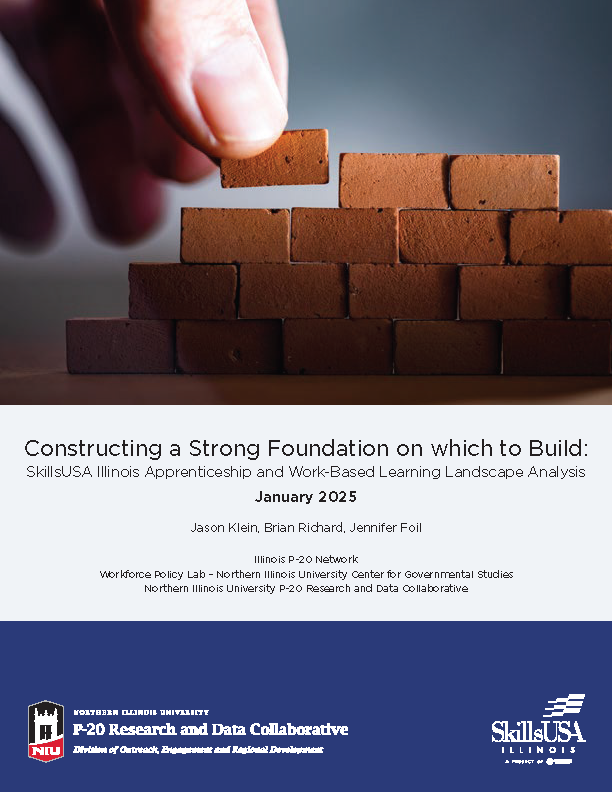
Update – 2025-March-07 – We are excited to have publish Constructing a Strong Foundation on which to Build: SkillsUSA Illinois Apprenticeship and Work-Based Learning Landscape Analysis.
With the support of SkillsUSA Illinois, throughout the Fall and Winter of the 2024-2025 year, a research team from the NIU P-20 Research and Data Collaborative comprised of the Illinois P-20 Network and the Workforce Policy Lab at the NIU Center for Governmental Studies has conducted a comprehensive overview of apprenticeship programs across Illinois, including their locations, the career fields they cover, and the demographics of current apprentices. This work has also focused on Work-Based Learning more broadly, including paid and unpaid internships. To complete this study, the team brought together existing governmental data sources from the United States Department of Labor and the Illinois State Board of Education as well as seeking input from both educators (school districts and postsecondary) and from business and community partners with two original surveys.
On Thursday, March 13, 2025, we will be hosting a webinar for educators to provide an overview of the results, the key themes, and the report’s recommendations. As a landscape analysis, this report is simply a starting point for future work, though we are both excited to have helped start moving Illinois further down the road of thoughtful data analysis as well as thankful for the support of SkillsUSA Illinois that allowed this work to take place.
March 2025Diane Sweeney Introduces the 2025 ECN Conference
We are excited to be welcoming Diane Sweeney back for this year’s ECN Conference on April 24, 2025. This session is ideal for coaches and administrators to attend as Diane will walk us through some of the most critical issues to get right for school culture, educators’ growth, the long-term success of instructional coaching, and, ultimately, for student success. Check out this short video Diane recorded for more information!
In addition to the ECN Conference, the Educational Coaching Network has also added new online, after-school workshops based on feedback from participants across Illinois. These sessions include…
- Data Rules Coaching Book Study
- Instructional Coaching Hot Topic – Recruitment: Inviting Teachers to Engage with Coaches
- Instructional Coaching Hot Topic – Working Effectively as Partners with Teachers and Your Administrative Colleagues
If you do not already receive the ECN Newsletter that comes out at the end of each month, sign-up for free today!
January 2025Empowering Futures: NACEP’s Annual Conference Unites Over 1,100 Concurrent Enrollment Professionals
This year, over 1,100 concurrent enrollment practitioners, researchers, and educators gathered in Orlando, Florida, for the annual NACEP (National Alliance of Concurrent Enrollment Partnerships) National Conference – a vibrant forum where leaders in dual credit, dual enrollment, and early college credit shared insights on advancing the field. As the sole accrediting body for concurrent enrollment partnerships, NACEP has long been committed to ensuring high standards of rigor and quality across programs, enabling high school students nationwide to embark on their college journeys while still in high school.
A focus on student experience and equity
The 2024 conference placed students’ experiences at the heart of its mission. Through discussions led by researchers and seasoned practitioners, attendees explored pressing topics like policy development, advising-counseling models, college-career pathways, and workforce engagement. With an unwavering commitment to improving concurrent enrollment programs, the conference offered numerous opportunities for participants to learn from some of the nation’s foremost experts and innovators in the field.
Representatives from Illinois made a noteworthy impact, with 71 dual credit practitioners—the second-highest group in attendance—showcasing work that has demonstrated tangible benefits for students transitioning to postsecondary education. These professionals highlighted effective strategies for equipping students with critical skills to navigate the complexities of higher education and workforce pathways. The high representation from Illinois underscored the state’s dedication to concurrent enrollment and the collective momentum toward building equitable access across regions.
Bridging research and practice for program excellence
NACEP’s conference reinforced the powerful connection between research and practice. Each session highlighted how cutting-edge research is central to advancing concurrent enrollment and improving programs nationwide. From discussions led by NACEP research commissioners to presentations by doctoral candidates and practitioners, a common thread emerged: rigorous research informs better programs and policies. This commitment ensures that programs not only meet accreditation standards but also respond to the evolving needs of students and educators alike.
Looking ahead: NACEP’s vision for nationwide collaboration
As the only national organization dedicated to concurrent enrollment professionals in all 50 states, NACEP continues to be an invaluable resource. Its leadership and expertise guide states in shaping robust concurrent enrollment systems where high schools and colleges work in partnership to support every student. This year’s conference reaffirmed NACEP’s commitment to expanding equitable access to college coursework, helping students build the skills they need to thrive in education and beyond.
NACEP’s annual conference remains a testament to the shared ambition of its members—an inspiring gathering of practitioners dedicated to empowering students’ futures through access to quality, college-level learning experiences.
October 2024The Road to Retention KEEP Illinois Report Released
This week, KEEP Illinois met to review the now released report, The Road to Retention: Understanding the educator shortage and ways to engage and keep educators. This report reviews the existing literature on educator retention and engagement as well as state and national data. The report also makes recommendations regarding both policies and practices that can enhance educator engagement (and, ultimately, retention).
During the KEEP Illinois meetings, participants discussed which recommendations should be priorities as well as which are most realistic. Following those discussions, KEEP Illinois participants will receive a short follow-up survey. Based on those survey results and the discussions, a KEEP Illinois action plan will be put into place and future efforts will focus on implementing policies and practices across Illinois that are likely to increase engagement for all educators so they can continue to thrive throughout their careers. The video included below provides a brief overview of the full report.
To stay up-to-date on what is taking place with KEEP Illinois, please visit the Illinois P-20 Network’s KEEP Illinois website and watch for upcoming Illinois P-20 Network Newsletters.
October 2024Dual Credit Think Tank – Legislative Priorities Survey Update
This week, the Dual Credit Think Tank met and reviewed the data that resulted from the Legislative Priorities Survey that was launched following the August 1 Legislative Update Webinar. The survey sought to identify which topics related to HB5020 were most important to the field. Once those topics were identified, the goal would be to relaunch dialogue on these topics among interested and diverse groups of practitioners from school districts and postsecondary institutions to try to arrive at compromise and consensus.
During this week’s Dual Credit Think Tank meetings, participants collaborative analyzed the data. They sought to identify what patterns emerged in the data and which topics respondents felt were most important for further discussion (including identification of the evidence that supported these topics).
As this Newsletter goes out, the Illinois P-20 Network team is reviewing the responses from Dual Credit Think Tank participants and identifying action steps, which will be communicated to Think Tank participants in the coming weeks. To stay up-to-date on what is taking place with the Dual Credit Think Tank, please visit the Illinois P-20 Network’s Dual Credit Think Tank website and watch for upcoming Illinois P-20 Network Newsletters.
October 2024Complete & share SkillsUSA Illinois Apprenticeship Study surveys
This fall, a research team from the Illinois P-20 Network and the Northern Illinois University Center for Governmental Studies Workforce Policy Lab will be working together with the support of SkillsUSA Illinois to conduct a comprehensive statewide landscape analysis of apprenticeships in Illinois.
We have just released two surveys – one focused on educational organizations and one for business and community partners.
Here’s what we’re asking for assistance with from our Illinois P-20 Network partners:
- Please complete the educational organization survey.
- Please share the business and community partners survey with any partners who engage in any type of work-based learning and ask them to complete this survey. (Link: https://niu.az1.qualtrics.com/jfe/form/SV_bdBpTXJT1gGlsGi)
This study has strong potential to identify significant gaps in work-based learning opportunities that exist either across Career Pathways or geographically. The only way that this study can fulfill its potential is for organizations across Illinois, large and small, to complete it! Thank you for your help in completing it and sharing it with others!
October 2024Important Dual Credit Think Tank Survey Seeking Responses
This summer, the Dual Credit Think Tank consistently engaged in work following the legislative session based on the goings-on with HB5020, including June and July meetings that identified topics and questions for legislators, and the Legislative Webinar on August 1.
Now, a survey regarding dual credit has been developed based on not only the August 1 webinar but also the conversations that took place during the June and July Think Tank meetings. This survey has two key purposes:
- The results of this survey will inform communications from the Dual Credit Think Tank to policymakers about what is important to the field, both school districts and postsecondary institutions, for continued efforts around HB5020 or around new legislative proposals.
- The results of this survey will also inform the Illinois P-20 Network for developing time-sensitive and needed professional learning opportunities to support school districts, postsecondary institutions, and regions with their efforts to develop dual credit programming for students.
While the survey is anonymous, we optionally request that participants complete the final section with your organization’s information. In that event, survey responses will still be kept confidential, but this additional data will allow us to engage in more detailed and complex analyses that include demographic and funding data from other sources.
Please complete this survey by Friday, September 6, 2024, and please share the link to the survey widely with other school districts and postsecondary institutions. We hope to have responses from organizations in communities throughout the state.
August 2024Launching Partner Plus – Join Us Today!
Since its inception ten years ago, participation in the Illinois P-20 Network has been free to participating organizations. Financial support for the Illinois P-20 Network has been provided by Northern Illinois University (NIU) and the NIU Division of Outreach, Engagement and Regional Development. For a period of time more than five years ago, there was additional funding from the Illinois Community College Board, and the Illinois P-20 Network has funded specific projects with contracts and grants from state agencies as well as by providing custom partner services on a fee-for-service basis to school districts and postsecondary institutions.
Over the past five years, demand for the knowledge and expertise provided by the Illinois P-20 Network has grown significantly. As a result, the Illinois P-20 Network seeks to meet that increasing demand with increasing capacity while also maintaining expert levels of knowledge and high-quality service. From answering questions via email to setting up short Zoom meetings on topics ranging from career and college readiness to educator engagement to instructional coaching to instruction and assessment, we are excited to partner with organizations across Illinois. Having a consistent revenue stream to support this work is critical for the sustainability of the Illinois P-20 Network and will help us meet increasing demand in these and other areas of need.
To continue (and expand) the current efforts of the Illinois P-20 Network, today we are launching Partner Plus. This is not only an opportunity to support the Illinois P-20 Network – but it also offers specific benefits for your organization.
August 2024ECN adds free Coaching Conversations
This year, the Educational Coaching Network (ECN) is adding another feature (for free!) to this year’s Foundations of Instructional Coaching and Advanced Coaching Workshops — Coaching Conversations.
The purpose of the Coaching Conversations is to give participants the opportunity to discuss and process the content with ECN facilitators. ECN participants are invited to bring their thoughts, questions, and ideas to Zoom, along with your lunch, for engaging conversation. These sessions, from noon to 1 PM, are free and included for all ECN participants! There are specific Coaching Conversations scheduled for both the Foundations of Instructional Coaching Institute and for the Advanced Coaching and Leadership Workshops. This is a new, additional value-add for participants and school districts as part of the Educational Coaching Network.
July 2024The Schools We Need Now Book Launch Webinars

Health and wellness, both mental and physical, are the focus of The Schools We Need Now, a new book by Tim Dohrer and Tom Golebiewski. This new book directly addresses our Area of Focus of Equity and Opportunity and indirectly addresses our Areas of Focus of Career and College and Readiness and Educator Engagement. To help launch it, the Illinois P-20 Network will host two webinars with Tim and Tom on June 25 and August 28.
The book lays out a “Mental Health Action Plan” that can guide educators to re-envision schools through the lens of health and wellness. It also provides school-based examples of prevention, intervention, and postvention steps for creating a healthy school culture.
Tim and Tom will be in conversation with Jason Klein and will take questions from the audience during the live webinars. Register below for either of the book launch webinars:
June 2024Kaneland School District 302 Awarded 2024 Coaching Champions

Launched at the 2023 ECN Conference and awarded to Glenbrook Township High School District 225 at that time, the Educational Coaching Network awarded its second annual ECN Coaching Champions award at this year’s ECN Conference on May 9, 2024, to Kaneland School District 302.
Over the past decade, Kaneland School District 302 has shown a broad and consistent commitment to instructional coaching. This commitment has been demonstrated through Kaneland’s staffing of instructional coaches to the priority and value it places on instructional coaching with teachers to the ongoing professional development that is provided to the district’s instructional coaches.
The Illinois P-20 Network Educational Coaching Network continues to see the extraordinary work being done across Illinois by teachers with students and by the coaches and school and district leaders who support those teachers. We are pleased to honor Kaneland School District 302 for their long-term success with instructional coaching and their desire to support teacher engagement and student achievement.
May 2024HB5020 Update – Next Steps in the Senate
At the time of this posting, HB5020 has made no movement through the Illinois Senate’s Assignments Committee or towards a floor vote in the Senate. Questions have appeared to emerge about whether this bill will move forward through the legislative process, and Illinois P-20 Network partners are asking questions about how they can impact the legislation.
As we have previously written on this topic, the Illinois P-20 Network takes no position on HB5020 itself. We do believe that well-designed dual credit coursework is one component of a high-quality and equitable approach to career and college readiness. Additionally, the Illinois P-20 Network continues to commit to:
- Share updates to the Dual Credit Think Tank, specifically, and to the field broadly.
- Provide opportunities for practitioners from both postsecondary institutions and school districts to share their feedback on key elements of discussion that are still being considered with the next amendment to HB5020.
In a previous post, the Illinois P-20 Network has explained how to file a witness slip for a committee. In addition to that, on this or any other bill (or any topic more broadly), educators can and should contact their elected officials in the General Assembly that represent the district(s) in which their organization resides as well as the elected officials that represent their personal residence.
Phone calls and emails that detail your experience and explain the impact of potential legislation are most helpful. Included concrete and verifiable data not only provides greater veracity to your arguments, but better substantiates your expertise in the field and should improve the overall quality of the legislative debate.
Continue to check on the Illinois P-20 Network News feed for updates on HB5020.
May 2024Lots of Free CTE Learning Opportunities for Educators
In February, the Summer 2024 ISBE CTE Professional Learning Calendar was released. The Summer 2024 Calendar includes 24 workshops, including in-person workshops across Illinois.
Today, the 2024-2025 ISBE CTE Professional Learning Calendar is released. In addition to the three online asynchronous professional learning courses that are running multiple times each year, this 2024-2025 Calendar features 65 workshops, including workshops focused on equity and closing opportunity and achievement gaps, workshops focused on new teachers, workshops focused on the integration of literacy and math instruction, workshops focused on CTE coursework in specific Career Pathways, and workshops to support administrators and counselors.
Please share with educators in your school districts and regions and register today!
May 2024HB5020 Update – To the Senate
As we continue to work to provide accurate and detailed updates to the field regarding HB5020 (previous updates here and here and here and here), we wanted to share that yesterday evening, Thursday, April 18, 2024, the Illinois House of Representatives overwhelmingly (and possibly unanimously) passed HB5020. It will now move to the Senate for consideration.
April 2024Announcing the Educational Coaching Network 2024-2025 Calendar
Update – May 9, 2025 – The Educational Coaching Network website has been updated for 2024-2025, and registration links are now live!
The Educational Coaching Network (ECN) is excited to announce its 2024-2025 professional learning calendar. All of these events will be held at the NIU Naperville Conference and Event Center, and workshops will be held on Tuesdays, Wednesdays, or Thursdays to help minimize the impact most schools and school districts are facing with the limited availability of substitute teachers.
Foundations of Instructional Coaching Institute
Jim Knight and the Instructional Coaching Group team return for the “Foundations of Instructional Coaching Institute” with five days of engagement for prospective or new instructional coaches as well as for instructional coaches who may not have previously engaged in an in-depth professional development experience around coaching. Jim Knight will be back to kick-off the Institute on November 13. The remaining sessions will be led by his colleague, Michelle Harris, an experienced teacher, instructional coach, administrator, and, today, a veteran presenter and the Director of Consulting for the Instructional Coaching Group.
- November 13 – Better Conversations
- February 4 – Impact Cycle Day 1
- February 5 – Impact Cycle Day 2
- March 11 – Data Matters
- March 12 – Teaching Practices
Advanced Coaching and Leadership Workshops
Each of these workshops, which can be attended as individual workshops or by registering for the entire series, takes a deep dive into specific aspects of coaching and leadership. These workshops will improve and refine the skills of coaches and educational leaders.
- February 24 – Advanced Coaching Skills – Jim Knight
- February 25 – System Design – Jim Knight
- March 18 – Coaching for Leaders Day 1 – Mary Webb
- March 19 – Coaching for Leaders Day 2 – Mary Webb
ECN Conference – April 24, 2025
Diane Sweeney will return to the Educational Coaching Network for the 2025 ECN Conference at NIU Naperville. Diane will be supporting district leaders, school leaders, and coaches with the implementation of Student-Centered Coaching, and this is a great opportunity for district and/or school teams to prepare for new or improved implementations for the 2025-2026 school year.
Registration for all of these events will open in May 2024 and be available on the Illinois P-20 Network’s Educational Coaching Network website.
April 2024HB5020 Update – Amendment 002
Update 3 – 12 PM – 17 April 2024 – This morning, the Higher Education Committee met and heard Amendment 002. HB5020 passed unanimously from the Committee, and the bill will now head to the House floor in its current form.
Update 2 – 3.45 PM – 16 April 2024 – The update below proved to be incorrect. The amendment was not able to be fully filed through General Assembly processes in time for today’s Higher Education Committee hearing. The full text of Amendment 002 is now posted on the General Assembly website. The Amendment will now be heard at a 10.30 AM Higher Education Committee hearing tomorrow, Wednesday, April 17, 2024. Witness Slips specifically for Amendment 002 can be filed at this Amendment 002 Witness Slip link. For directions on how (and why) to file a Witness Slip, check out this previous HB5020 News post on the Illinois P-20 Network website.
Update – 3 PM – 15 April 2024 – As we understand it, and while it has not yet been confirmed with posting on the General Assembly’s website, the Higher Education Committee will hear Amendment 002 to HB5020 at 11 AM on Tuesday, April 16, 2024.
HB5020 is an amendment to the Illinois Dual Credit Quality Act, and throughout this legislative process, the Illinois P-20 Network remains committed to:
- Share updates to the Dual Credit Think Tank, specifically, and to the field broadly.
- Provide opportunities for practitioners from both postsecondary institutions and school districts to share their feedback on key elements of discussion that are still being considered with the next amendment to HB5020.
As stated in last week’s update following the April 3, 2024, hearing of the Higher Education Committee, work continued with key stakeholders on an additional amendment. A range of parties have agreed to updated components of the legislation (outlined below) that will be included in Amendment 002, which is currently being officially drafted by the General Assembly’s Legislative Reference Bureau (LRB). Once posted by the LRB, the bill will return to the Higher Education Committee for another hearing, which is expected to be early next week. If approved by the Committee, the bill will then be up for a floor debate in the Illinois General Assembly House of Representatives. This floor debate must also take place next week, and as a result, it is expected that the HB5020 with Amendment 002 will, once again, be called before the Higher Education Committee early next week.
As the process evolves, anyone can view updates to the status of HB5020 on the Illinois General Assembly’s website. Additionally, the Illinois P-20 Network will continue to provide updates as quickly as possible to members of the Dual Credit Think Tank as well as posting News updates on our website and communicating via the every-other-week Illinois P-20 Network Newsletter.
Amendment 002 completely replaces Amendment 001, and this is referred to as a gut and replace. As of this posting, key components of the legislation include: (Please note that items below that new or updated elements from Amendment 002 have been noted in-text.)
Amendment 002 defines fully-qualified instructors as instructors who either a) meet the academic credentials which are defined as a master’s degree within the discipline to be taught or any master’s degree and not more than 18 graduate hours in the discipline to be taught; or b) is a career and technical education (CTE) instructor who meets the equivalent experience that is commensurate with achievement of academic credentials, as defined by the Dual Credit Instructor Qualification Framework. This is a new addition to the legislation in Amendment 002.
Amendment 002 defines minimally qualified instructors as instructors who are enrolled in a Professional Development Plan and either (a) have a master’s degree in any discipline and have completed a minimum of 9 hours of the graduate coursework requirements of the Dual Credit Instructor Qualification Framework for the course; or, (b) are a fully licensed CTE instructor who is halfway toward meeting the required equivalent experience criteria defined by the Dual Credit Instructor Qualification Framework. This is a new addition to the legislation in Amendment 002.
Amendment 002 expands the purpose of the Dual Credit Quality Act (DCQA) to emphasize the importance of collaborative local partnerships to provide meaningful dual credit opportunities to students and close opportunity gaps.
Amendment 002 requires school districts and community colleges to each designate a liaison and begin partnership negotiations within 60 calendar days of the school district’s initial request.
Amendment 002 offers parity in Priority Career Pathway courses with Illinois Articulation Initiative course offerings to expand opportunities for students for Priority Career Pathways that already exist at the community college.
Amendment 002 uses the standards established by the Developmental Education Reform Act (DERA) for student eligibility measures that recognize a broader range of student achievement, and ICCB will begin collecting data on what multiple measures are being used.
Amendment 002 requires clear communication plans and advanced notice for students and families, so they understand opportunities for early college credit and the necessary prerequisites.
Amendment 002 stipulates that course evaluations should occur within the same school year the course is taught to maintain rigorous standards.
Amendment 002 requires community college districts to reinvest revenues received from school districts for dual credit programming back into dual credit programming.
Amendment 002 allows high schools to use their district policies to determine class size, student technology access, and student accommodations if the course is taught by high school instructors at the high school and only if these policies do not interfere with rigorous student learning outcomes. Amendment 002 does stipulate that these district policies may not interfere with rigorous student learning outcomes. The language around this provision has been updated in Amendment 002.
Amendment 002 allows high schools to coordinate with their higher learning partner to determine course length and number of sections an individual instructor may teach for courses taught by high school instructors at the high school to ensure maximum student access while maintaining rigorous student learning outcomes.
Amendment 002 empowers school districts to offer dual credit courses equal weight with Advanced Placement and International Baccalaureate courses. This is updated language in Amendment 002, in which “districts shall equally weight” from the original HB5020 text was changed to “districts may equally weight.”
Amendment 002 provides that if a community college disapproves of a course request…
- Creates a mechanism within ICCB to review instructor credential denials, which provides another avenue to resolve disputes between a high school and community college and keep more courses available through local partnerships rather than alternative providers.
- Allows high schools to engage an alternative provider for a particular course if their partnering community college disapproves of that course request.
- Permits a community college to reevaluate the course request annually to approve the course and offer the course as originally proposed.
Amendment 002 prohibits dual credit partnerships with for-profit postsecondary institutions.
Amendment 002 codifies the right of community colleges to have first refusal with local partnerships.
Amendment 002 requires all institutions (4-year, 2-year, public, private, in-state, out-of-state) offering dual credit to follow the elements of a dual credit partnership agreement established in section 16 of the Dual Credit Quality Act.
Amendment 002 further limits the use of out-of-state providers by requiring high schools to demonstrate to the IBHE that it has taken appropriate steps to use in-state institutions and must provide rationale if using an out-of-state institution.
Amendment 002 requires IBHE to publish a list of partnership agreements with both out-of-state and private institutions. The update in Amendment 002 adds private institution to this language.
Amendment 002 reconvenes the Model Partnership Agreement Committee biennially.
Amendment 002 defines “academic credentials” as master’s degree within the discipline to be taught or any master’s degree and not more than 18 graduate hours in the discipline to be taught.
Amendment 002 extends professional development plans in perpetuity to address the ongoing teacher shortage and growing student demand for dual credit coursework.
Amendment 002 strikes language allowing instructors with only a bachelor’s degree to enter a Professional Development Plan. This is a change in Amendment 002 from the previous versions of HB5020.
Amendment 002 entrusts the annual course review to the higher learning partner’s faculty department chair and the chief academic officer (or their designees).
Amendment 002 charges ICCB to conduct a study to examine the long-term and short-term outcomes for differing dual credit hour attainment. This is a new addition to HB5020 in Amendment 002.
Amendment 002 creates the Dual Credit Committee, a 29-member committee of secondary and postsecondary representatives to define two specific components: (1) the appropriate graduate coursework within disciplines covered by the Illinois Articulation Initiative (IAI) for academically qualified and interim qualified instructors; and, (2) the equivalent experience required to be a fully qualified CTE instructor.
April 2024HB5020 Update
An update on developments with HB 5020 in Springfield today
On April 3, 2024, the Higher Education Committee held a hearing and among the bills heard was HB5020, an amendment to the Dual Credit Quality Act. Multiple people representing interest groups testified and shared their positions, and ultimately, there was a commitment to continue negotiations on an additional amendment to the legislation that is currently being drafted with additional stakeholder feedback. The Illinois P-20 Network will continue to do two things as this process moves forward:
- Share updates to the Dual Credit Think Tank, specifically, and to the field broadly.
- Provide opportunities for practitioners from both postsecondary institutions and school districts to share their feedback on key elements of discussion that are still being considered with the next amendment to HB5020.
Once the amendment in development is complete, HB5020 will come back to the Higher Education Committee for review.
As a reminder, through the legislative process, there may be changes to items listed below. This list simply captures key elements of HB5020 that have been agreed upon at this time. HB5020…
- Expands the purpose of the Dual Credit Quality Act (DCQA) to emphasize the importance of collaborative local partnerships to provide meaningful dual credit opportunities to students and close opportunity gaps.
- Requires school districts and community colleges to each designate a liaison and begin partnership negotiations within 60 calendar days of the high school’s initial request.
- Offers parity in Priority Career Pathway courses with Illinois Articulation Initiative course offerings to expand opportunities for students for Priority Career Pathways that already exist at the community college.
- Uses the standards established by the Developmental Education Reform Act (DERA) for student eligibility measures that recognize a broader range of student achievement, and ICCB will begin collecting data on what multiple measures are being used.
- Requires clear communication plans and advanced notice for students and families so they understand opportunities for early college credit and the necessary prerequisites.
- Stipulates that course evaluations should occur within the same school year the course is taught to maintain rigorous standards.
- Requires community college districts to reinvest revenues received from school districts for dual credit programming back into dual credit programming.
- Offers dual credit courses equal weight with Advanced Placement and International Baccalaureate courses.
- Prohibits dual credit partnerships with for-profit institutions.
- Codifies the community college’s right of first refusal.
- Requires all institutions (4-year, 2-year, public, private, in-state, out-of-state) offering dual credit to follow the elements of a dual credit partnership agreement established in section 16 of the DCQA.
- Further limits the use of out-of-state providers by requiring high schools to demonstrate to the IBHE that it has taken appropriate steps to use in-state institutions and must provide rationale if using an out-of-state institution.
- Reconvenes the Model Partnership Agreement Committee biennially.
- Defines academic credentials as master’s degree within the discipline to be taught or any master’s degree and not more than 18 graduate hours in the discipline to be taught.
- Extends professional development plans in perpetuity to address the ongoing teacher shortage and growing student demand for dual credit coursework.
- Entrusts the annual course review to the higher learning partner’s faculty department chair and the chief academic officer (or their designees).
- Creates the Dual Credit Committee, a 29-member committee of secondary and postsecondary representatives to define two specific components: (1) the appropriate graduate coursework within disciplines covered by the Illinois Articulation Initiative (IAI) for academically qualified and interim qualified instructors; and, (2) the equivalent experience required to be a fully qualified Career and Technical Education instructor.
- If a community college disapproves of a course request…
- Creates a mechanism within ICCB to review instructor credential denials, which provides another avenue to resolve disputes between a high school and community college and keep more courses available through local partnerships rather than alternative providers.
- Allows high schools to engage an alternative provider for a particular course if their partnering community college disapproves of that course request.
- Permits a community college to reevaluate the course request annually to approve the course and offer the course as originally proposed.
In addition to the updates that are being provided by the Illinois P-20 Network, anyone can view the current text of HB5020 as well as its current status on the Illinois General Assembly website.
April 2024HB5020 – Share your expertise | Impact the process
UPDATE – 21-March-2024 – 11.05 AM – The Illinois P-20 Network understands that HB5020 will no longer be called before the Higher Education Committee later today. Rather, additional work is likely to take place with various stakeholders as a next step. As the Illinois P-20 Network receives additional updates, those will be communicated to the Dual Credit Think Tank and to the field. Additionally, throughout this process, the Illinois P-20 Network will continue to engage and encourage the involvement of educators from both school districts and postsecondary institutions to put into place the best possible solutions for our collective students.
Tomorrow, Thursday, March 21, 2024, at 4 PM, HB5020 (See this previous HB5020 post for more information) is scheduled for a hearing with the Higher Education Committee. In advance of this, educators and other members of the public can file witness slips to share their expertise and to impact the legislative process. Witness slips allow members of the public to file in support of a bill, in opposition of a bill, or one can even file a neutral witness slip.
The purpose of sharing this is two-fold. First, dual credit is one critical element of our focus on Career and College Readiness, and the Dual Credit Think Tank has been actively working in this area for over four years alongside ILACEP and other key stakeholders who seek to improve dual enrollment and early college opportunities for students. The Illinois P-20 Network takes no position in favor of or in opposition to HB5020. Rather, our primary objective in sharing this is to ensure that practitioners impact policy outcomes.
One critical function of the Illinois P-20 Network is to ensure that the voices of practicing educators are able to be part of legislative and policymaking processes in order to support our goal of implementing engaging and effective assessment and instructional strategies for all learners.
To complete a witness slip, visit the Illinois General Assembly’s HB5020 web page, and follow the steps listed below. Again, a witness slip can and should be completed any time up to when the hearing ends, and it is a critical way for the expert voices of educators to influence the policymaking process.
When you first are on the General Assembly’s web page for a specific piece of legislation, you will notice that you have access near the top of the page to the full text of the legislation. Additionally, any sponsors of the legislation are listed, and just below that, highlighted in the image below, any upcoming hearings for this piece of legislation are also listed.
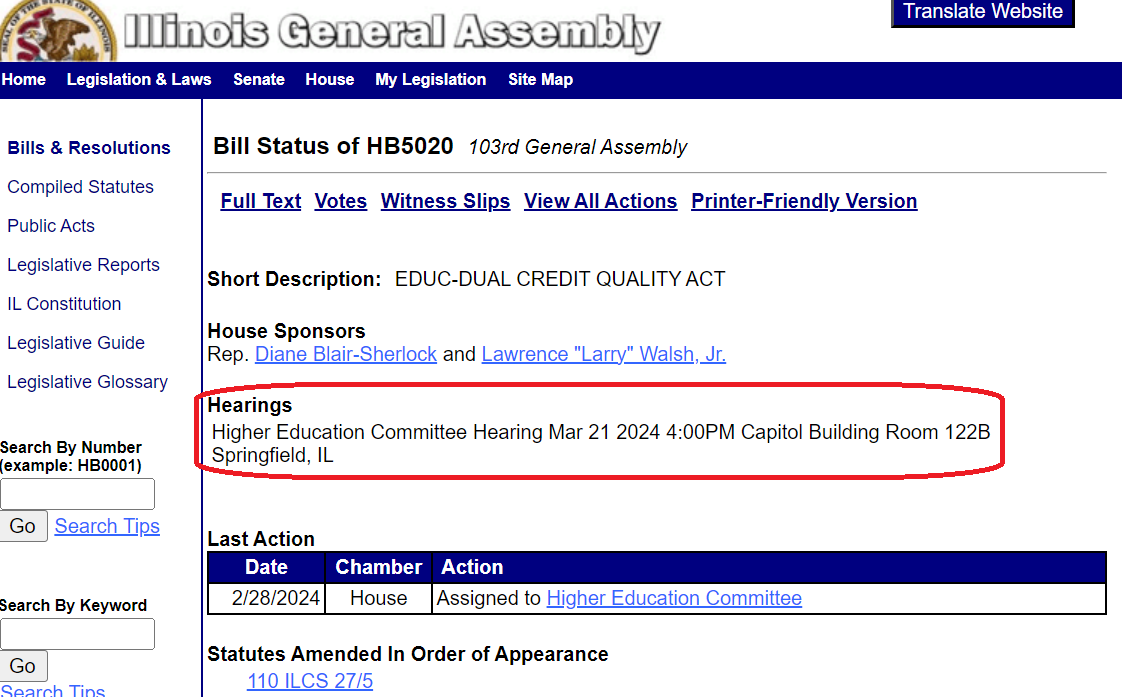
There are a series of steps that a user needs to click through in order to actually create a witness slip. These apply not only to HB5020 but to all bills introduced in the Illinois General Assembly. The first step is to click the “Witness Slips” link near the top of the page.
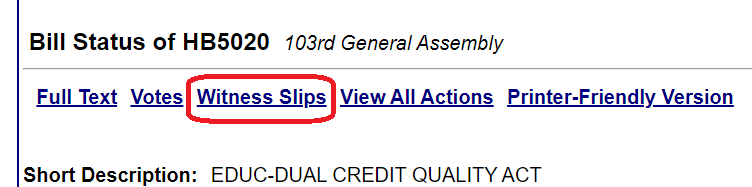
On the next page that loads, you can see who has issued witness slips in support of the bill, in opposition to the bill, and with no position. Near the top of this page, there is a link that you should click on to continue to move through the process to create your own witness slip.
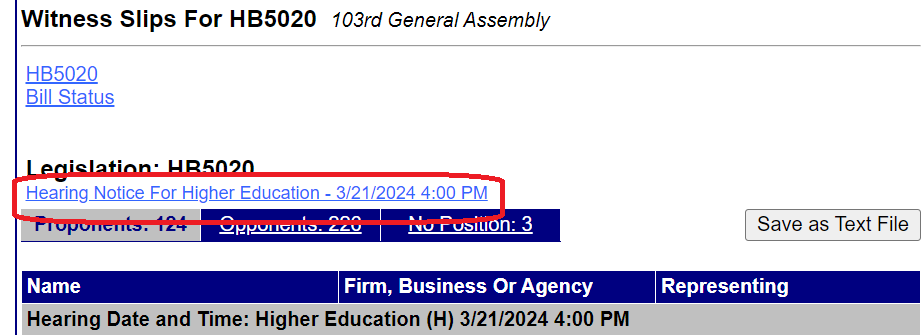
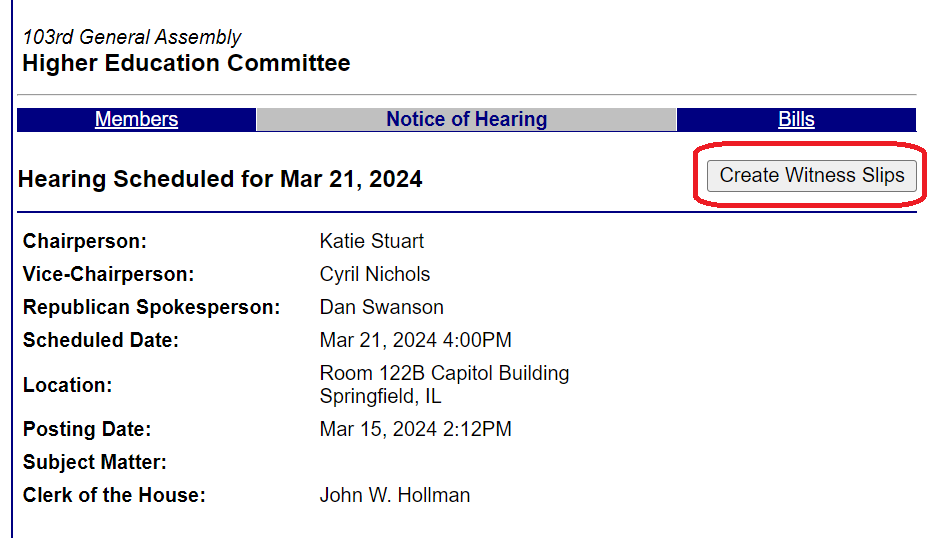
On the next page, click the “Create Witness Slips” button on the right side of the web page as pictured below.
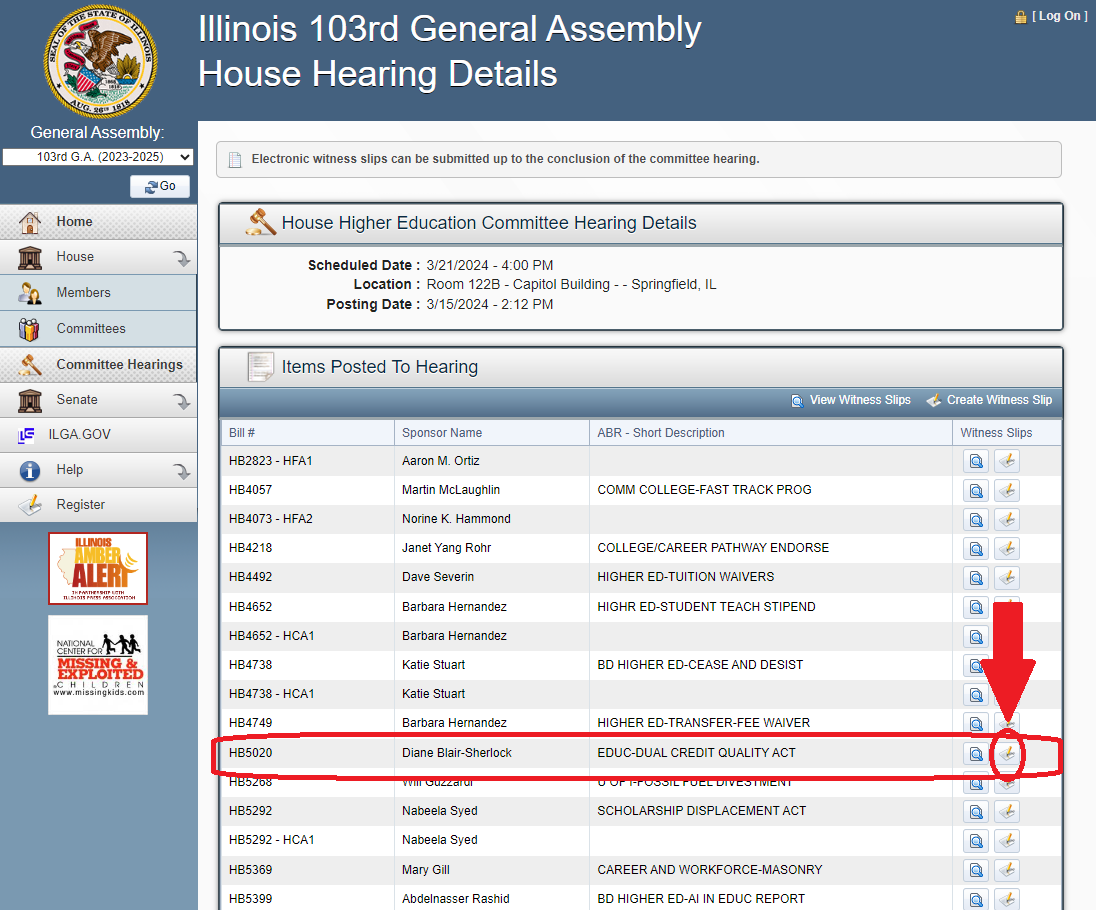
Now, a completely new website will load in your browser with an entirely different appearance. On this page, you need to find the bill on which you want to leave a witness slip. Once you have identified that bill’s row, you will click the icon on the far right of the row to create your own witness slip. (That button is circled in the image below.)
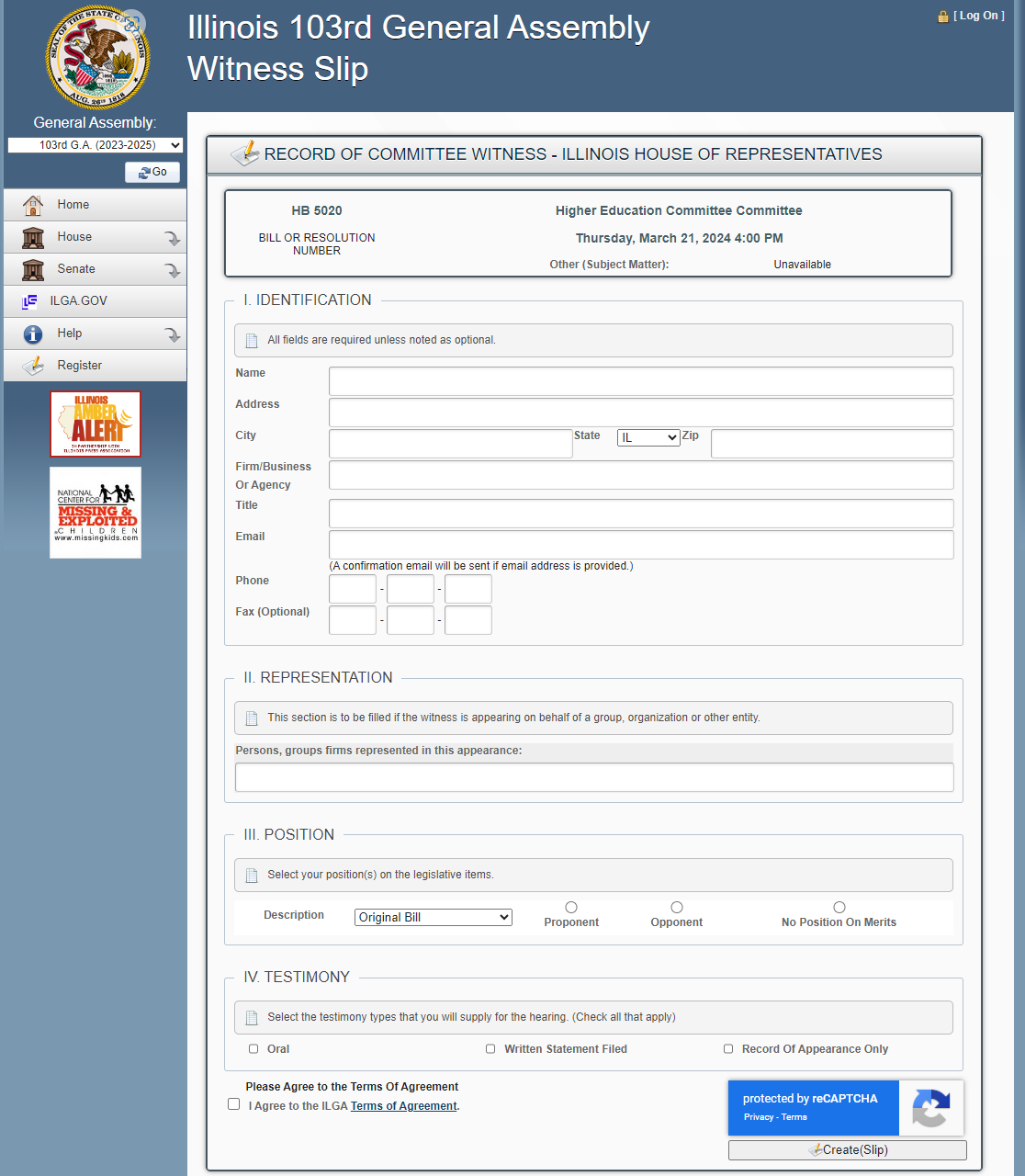
The Witness Slip form will now open. Complete this entire form. Be sure to provide your context and expertise. If you have data, include that data (while, obviously, protecting the privacy of personally identifiable information). Before you can submit, you do need to check the checkbox in the lower left corner in order to agree to the terms of the site before you can submit.
KEEP Illinois Update: Deepening Our Understanding of the Teaching Profession and Educator Engagement
Work continues in earnest on a review of research about educator retention and engagement. This is part of a larger project to understand the field and provide districts and policymakers with guidance on how to help teachers and administrators thrive. At the March Forum, a group of educators from across the state came together to discuss a 2022 study from Matthew Kraft and Melissa Lyon entitled, “The Rise and Fall of the Teaching Profession: Prestige, Interest, Preparation, and Satisfaction over the Last Half Century.” Participants noted that the teaching profession has had cycles of high or low interest depending on a variety of forces, with today’s levels being at historic lows. Those forces create a complex problem that can’t be solved easily, but the group has started to identify some local and broader changes that could result in greater job satisfaction and elevate the profession.
Studies like this are being added to a growing database of research that will culminate in a series of reports and resources educators and leaders can use to enact policies that will result in greater retention and more positive school cultures for educators across Illinois.
If you want to learn more about KEEP Illinois, contact Tim Dohrer (tdohrer@niu.edu).
March 2024Sprinting toward new priorities
Following the Illinois P-20 Network Meeting, held on November 29, 2023, the leadership team of the P-20 Network has spent time organizing, coding, and analyzing the feedback about short- and medium-term priorities from participants in the Meeting.
A new approach to project management to accomplish tasks and be agile
Based on that feedback, first, the Illinois P-20 Network will be adopting a modified sprint planning approach to project management. In this approach, short-term goals are identified and set-up for accomplishment over an equally short period of time. This approach to project management is most frequently used in software development, in which 6-week sprints are often the norm. Following each sprint, a project team typically takes the following week for bug fixes in the software as well as for identifying the goal of the next 6-week sprint and laying out a corresponding project plan for that sprint.
Educational organizations typically organize around 1-year goals and plans (e.g., School Improvement Plans) and longer 3- to 5-year strategic plans. Schools, school districts, and postsecondary institutions benefit from the long-term focus over time that is tied to sticking with a consistent small set of goals over many years to move the entire organization forward in deep and lasting ways. For the Illinois P-20 Network, on the other hand, sprint planning is beneficial because it allows Network members to quickly see tangible benefits from the Network’s work on an ongoing basis and because it allows the Illinois P-20 Network to be nimble and adjust to changes in policy and/or the needs of its constituent member organizations.
To this end, each of the workgroups has set targeted goals for the third quarter of the 2023-2024 academic year. We will update all Illinois P-20 Network members on our progress toward each of these targets this spring.
Next steps for Illinois P-20 Network Workgroups
Dual Credit Think Tank – With the successful and large in-person gathering at the Fall P-20 Network Meeting, the Dual Credit Think has continued to provide direct opportunities for practitioners at both the school district and postsecondary levels to offer feedback on Stand for Children Illinois’ proposed amendment to the Dual Credit Quality Act. In the weeks to come, the Dual Credit Think Tank will focus on facilitating conversations for practitioners to continue to influence the legislative process as it unfolds in Springfield with their on-the-ground experiences. A second priority that the Dual Credit Think Tank will undertake alongside this effort, a series of professional learning opportunities regarding developing a common understanding of the 2022 amendment to the Dual Credit Quality Act will take place in February, March, and April. If you are not already in the Dual Credit Think Tank and would like to be, please contact Rodrigo López.
IPIE – Based on feedback from the Fall P-20 Network Meeting and the ongoing work of IPIE, over the next three months IPIE will offer monthly online sessions focused on supporting districts with analyzing district and school data for the planning and implementation of their work around the ISBE Equity Journey Continuum. To become involved in IPIE and/or attend upcoming meetings, please complete this short IPIE interest form.
KEEP Illinois – Over the next few months, KEEP Illinois will publish three white papers based on the existing literature on the following topics: educator retention broadly, instructional coaching and its impact on educator retention, and the impact of wellness policies and practices on educator retention. Each of these will also be presented as a practitioner-focused webinar as they are completed. During this period, KEEP Illinois will also commence a regular pattern of monthly meetings to discuss research, best practices, and additional action steps. If you are not already a part of KEEP Illinois and would like to be, please contact Tim Dohrer.
December 2023Workgroup details for the Fall 2023 Network Meeting
With educators who serve students of all ages coming to Naperville on November 29, 2023, from across the state, you do not want to miss this important event. Colleagues from school districts, community colleges, and universities, as well as state agencies and professional organizations, will be attending to help move our educational systems forward together.
The majority of our time will be spent in three workgroups. Participants can join a workgroup even if they have not previously participated with that group in-person or online. All are truly welcome to roll-up their sleeves, attend, and participate!
IPIE – Illinois Partnership for Inclusion and Equity – This transformative data-driven equity workshop is the culmination of insights garnered from IPIE’s expansive membership. This workshop will first review annual trends in DEI before teaching participants to pinpoint and dissect achievement, opportunity, and racial discipline gaps with the precision of the Illinois Report Card. Join us and engage in rich discussions around local district data, sparking innovative strategies to amplify equity initiatives. This workshop concludes by bridging Illinois Report Card equity gap data with actionable steps; guiding districts in enhancing their Equity Journey Continuum. Elevate your district’s commitment to equity!
KEEP Illinois – Keeping Educators Engaged Professionally – The goal of KEEP Illinois is to keep educators engaged in learning and growing as professionals throughout their career. If we are successful with this effort, we will impact the ongoing educator shortage by stopping (or significantly decreasing) the flow of educators out of the profession and improve the daily lives of educators–and, as a result, their students. This work session will focus on developing action plans we will implement in the coming months to improve the conditions for teachers and administrators across Illinois.
Dual Credit Think Tank – The Dual Credit Think Tank will bring members of the dual credit community together to discuss how the recent policy changes that the Higher Learning Commission made to its faculty qualifications will affect policy and practice in Illinois. Participants will learn from secondary, postsecondary, and policy experts about dual credit teacher credentialing practices in Illinois. Members will work to outline the most pressing challenges faced by dual credit partnerships and aim to identify policy-driven solutions. Topics will include course selection, minimum qualifications to teach, partnership agreements, student services/development, and class size/caps.
November 2023Doing the Work: Illinois P-20 Network Fall 2023 Meeting
This year, the Fall Meeting of the Illinois P-20 Network will be held on Wednesday, November 29, 2023, from 9.30 AM until 1.30 PM at NIU Naperville. While we will spend a short period of time together at the beginning of the day to set the stage and to frame our work, the majority of the Meeting will be spent as dedicated, in-person worktime for each of the following Illinois P-20 Network workgroups:
- Dual Credit Think Tank
- Illinois Partnership for Inclusion and Equity
- KEEP Illinois – Keeping Educators Engaged Professionally
For those that have been a part of these groups, we hope you can join us in-person in Naperville on November 29. For those that have not, please join us on November 29 and lend your voice to one or more of the workgroups – Everyone is not only welcome but encouraged to join us!
The day will conclude with a short sharing session and lunch. To help offset the costs of the in-person event, we are asking participants for a small registration fee of $30. Thank you for your understanding!
September 2023An Overview Webinar of HLC’s Proposed Policy Changes
On September 6, 2023, Rodrigo López, Director of P-20 Initiatives at Northern Illinois University, and Aimee Galvin, Government Affairs Director at Stand for Children Illinois, hosted an informational webinar for educators across Illinois on behalf of the Illinois P-20 Network’s Dual Credit Think Tank.
With attendees from across Illinois representing secondary and postsecondary institutions, Rodrigo and Aimee reviewed the Higher Learning Commission’s (HLC) proposed policy changes to Faculty Qualifications, resulting from the HLC’s Board of Trustees’ first reading of the policy this past summer. The Board is expected to vote on the proposed Faculty Qualifications policy during their upcoming meeting this November.
The webinar provided background context to these proposed policy changes, and the webinar also provided information on the current policy and guidelines (Determining Qualified Faculty Through HLC’s Criteria for Accreditation and Assumed Practices) as noted in the Assumed Practices – CRRT.B.10.020. Aimee from Stand for Children Illinois offered an overview of their organization’s philosophy on dual credit and shared some thoughts on potential implications for both school districts and postsecondary institutions in Illinois, which are included in the Stand for Children Illinois HLC Proposed Rule Change Comment Letter.
Next Steps for Practitioners to Consider (and for Action)
The proposed policy changes and the information shared by the Dual Credit Think Tank present a time-sensitive opportunity for both school districts and postsecondary institutions to engage in a conversation about how these changes may impact their goals and their directions moving forward. For example, the HLC is seeking to adopt Progress toward academic credentials as an alternative to approve instructors to teach college courses. In the context of dual credit, this allows dual credit partnerships to construct a framework to explore the use of Professional Development Plans as a means to be credentialed to teach dual credit courses, similar to what is described in the Dual Credit Quality Act. Additionally, Illinois P-20 Network partners might find value in learning more about implementing a local policy that uses Equivalent Experience to increase dual credit instructors within career and technical education.
Understanding that dual credit partnerships from across Illinois face their own unique challenges, the Dual Credit Think Tank encourages all members to critically analyze the proposed policy changes and participate in the open comment period.
Please note that comments to HLC regarding this proposed policy change remain open through September 18, 2023. Comments can be provided to HLC via email: policycomments@hlcommission.org
The full webinar can be viewed on YouTube or below.
The Higher Learning Commission’s Proposed Policy Changes to Faculty Qualifications
On June 22, the Higher Learning Commission (HLC) Board of Trustees had the first reading of the changes to its Faculty Qualifications policy. The HLC Board is expected to vote on this proposal at its November 2023 meeting following the proposal’s second reading.
Aimee Galvin from Stand for Children Illinois and Rodrigo Lopez from the Illinois P-20 Network will host an informational webinar on the HLC’s proposed policy changes and share comments submitted to the HLC as part of their open comment period. They will also share a range of perspectives on the potential implications as gathered from the field.
The webinar will be hosted on September 6th from 3-4 PM. We invite you to attend by registering using this online Google form.
Please note that comments to HLC regarding this proposed policy change remain open through September 18, 2023. Comments can be provided to HLC via email (policycomments@hlcommission.org).
Please continue reading below for additional background and details about these proposed HLC policy changes.
Background
The HLC is one of the six regional accreditors in the United States. The proposed changes, if approved, apply to all postsecondary education institutions accredited by the Commission in the State of Illinois, along with 18 other states. These changes would revise “the faculty qualification provision in HLC’s Assumed Practices (B.2) to emphasize that an institution must establish and maintain processes for determining that instructors are qualified.”
The proposed policy changes are based on the feedback that the HLC has compiled over the past several years. More recently, the HLC held conversations with leadership from the Midwestern Higher Education Compact (MHEC) and the National Alliance of Concurrent Enrollment Partnerships (NACEP), two of the most critical and knowledgeable organizations on dual credit.
Faculty Qualifications: Proposed Policy Changes
The proposed HLC changes would give postsecondary educational institutions flexibility to establish local procedures that determine qualified faculty based on “the achievement of academic credentials, progress toward academic credentials, equivalent experience, or some combination thereof.”
Furthermore, the HLC has drafted “Institutional Policies and Procedures for Determining Faculty Qualifications Guidelines” to support colleges/universities determined “reasonable” procedures in accordance with the newly proposed changes.
- Achievement of academic credentials – “An instructor possesses an academic degree relevant to the discipline and at least one level above the level they intend to teach.”
- Progress toward academic credentials – “Demonstrable, current, and consistent progress toward the academic credential(s) deemed relevant by the institution for an instructor to be qualified.”
- Equivalent experience* – “Experience commensurate with achievement of academic credentials such that it qualifies an instructor for the instruction (e.g., a minimum threshold of experience; research and/or scholarship; recognized achievement; and/or other activities and factors).” (Experience with classroom instruction as a teacher cannot alone constitute equivalent experience.)
Expanding the NIU Illinois CTE Project Team
The NIU Illinois CTE Project, one key component of the larger Illinois P-20 Network Team, is contracted by the Illinois State Board of Education’s CTE & Innovation Team to collaborate with ISBE and educators across Illinois in leading CTE-related professional learning; evaluating, identifying, creating, and sharing instructional resources; supporting the goal of having high-quality and diverse CTE educators in classrooms across Illinois; and implementing ISBE’s annual Career Connections Conference.
As schools across Illinois begin the 2023-2024 school year, we are excited to announce two new members of our NIU Illinois CTE Project Team:
Brian Rick – Brian joins the team with a background having served as a high school CTE teacher as well as having worked in CTE at the community college-level and in the Regional Office of Education setting. Brian has extensive experience in construction and engineering classrooms, with Perkins V and its related processes, in implementing and leading Skills USA within a school district, and with leading efforts to close opportunity gaps for all students. Most recently, Brian has served as the CTE Navigator at Southeastern Illinois Community College having also previously worked at Vienna High School, ROE 20, Shawnee Community College, and at Carbondale High School. Brian has been involved in IACTE, and this past year, Brian was also part of ACTE’s IAED Diversity Cohort.
Betsy Westergreen – Elizabeth (Betsy) Westergreen joins the team having most recently served as the Career and Community Services Coordinator at Pontiac Township High School. In addition to teaching in this role, she was actively involved in leading schoolwide efforts to implement the PaCE Framework and the Work-Based Learning Continuum as well as serving as a liaison with community and business partners and the community college. Prior to her most recent role, Betsy also worked on the Innovative Curriculum Resource Project at Illinois State University under contract with ISBE, and Betsy served for many years as a CTE teacher in Flanagan-Cornell Unit School District 74 in which she taught classes across the Arts and Communications, Finance and Business Services, and Information Technology Career Pathways as well as leading a range of student activities.
Over the coming weeks and months, we look forward to the opportunities that teachers, counselors, and administrators across Illinois will have to collaborate with Brian and Betsy alongside current NIU Illinois CTE Project Team members Shavina Baker and Bill Rose.
August 20232023-2024 Professional Learning Calendars
ISBE and the NIU Illinois CTE Project Team, part of the Illinois P-20 Network, invite you to participate in a variety of professional development opportunities this school year, including:
- Online Professional Learning Courses
- CTE & Equity Promising Practices
- Administrator Academies – Open to All
- Illinois Career Pathways Overview
- Social & Emotional Learning Leads to College & Career Readiness
- PaCE Framework Overview
- Forming Relationships with Community and Business Partners
- Teaching & Assessing the Essential Skills in CTE
- Writing Team-Based Challenges
- Career Pathway User Group
- ISBE Career Connections Conference – June 18, 2024 – Tinley Park Convention Center
For more information and to register, please visit the ISBE CTE Professional Learning Calendar – 2023-2024. Additional workshops will be added to the calendar moving forward!
July 2023Expanding our P-20 Network Team
The Illinois P-20 Network is excited to announce that Tim Dohrer, currently the Director of Teacher Leadership at Northwestern University’s School of Education and Social Policy, will be joining Northern Illinois University beginning on September 1, 2023. Tim will be serving as our new Director of Educator Leadership and Partnerships, and his role is an appointment across the Northern Illinois University College of Education and the Illinois P-20 Network in the Division of Outreach, Engagement and Regional Development.
Prior to his role at Northwestern, Tim served as a teacher, instructional leader, and as the principal at New Trier High School. Tim brings a wealth of on-the-ground experience with him as well as continued work alongside educators in schools in his current role.
At NIU, Tim will continue to lead the Educational Coaching Network (ECN) as well as provide leadership for KEEP Illinois, engage across Illinois P-20 Network efforts, and partner with school districts, community colleges, and other organizations on the creation and implementation of degree and licensure programs through the NIU College of Education. Please join us in welcoming Tim to NIU and the Illinois P-20 Network!
July 2023NIU Illinois CTE Project is Hiring
UPDATE – Apply now for our CTE Educator position. Applications are now open with a priority review date of June 23, 2023.
The NIU Illinois CTE Project Team is excited to announce that we will be hiring a CTE Educator. While the position’s official job vacancy posting is not yet out, as the school year is wrapping up across Illinois, we wanted to share this opportunity as widely as possible, and we want to stress that candidates for this position will be considered from across Illinois.
This position presents an incredible opportunity to work with educators and school districts across Illinois and to partner closely with the Illinois State Board of Education’s Career and Technical Education team.
Highlights of the Job Description
The CTE Educator is an instructor in the Northern Illinois University Division of Outreach, Engagement, and Regional Development (OERD). Outreach and Engagement Instructors are professionals who conduct the division’s multitude of outreach and engagement activities with customers and partners across the region. This position will be primarily focused on instructional tasks – curriculum development, delivery of instruction, assessment and evaluation. Outreach and Engagement Instructors operate independently with minimal supervision and collaborate intentionally with colleagues across the division and across the university.
Duties and Responsibilities
Curriculum Development
- Lead development of instructional programs for students and teachers of all ages including, but not limited to new units of activities for students and teachers in both domestic and international settings.
- Research and develop curriculum and instructional activities, select books and other instructional materials, create videos of experts and authors as needed for the units.
- Investigate, develop, and promote new and innovative programming opportunities, especially those tailored to the needs of students with disabilities.
- Recruit and collaborate with NIU faculty, staff, and students to participate in NIU CTE and NIU CTE instructional programs.
- Write lessons, podcasts and other curricular materials that are aligned to standards and focus on building CTE and CTE skills.
Instructional Delivery – 30%
- Create proposals to deliver instruction in school classrooms, field, clinics, camps, across campus and online or other learning environments.
- Deliver high-quality instruction as an individual or part of a team that performs within timelines and within budgets and meets evaluation expectations.
- Deliver CTE instruction to families and community members in schools and communities on campus and off campus during school days, evenings, weekends, and summers.
- Monitor regional and national literacy news, research and publications a to identify opportunities for new programs and partners.
Assessment and Evaluation – 20%
- Study and use best practices for CTE instruction.
- Conduct a continuous improvement process, identifying metrics that establish accountability for CTE projects.
- Collect metrics and complete analyses as needed to determine effectiveness.
- Complete reports on outcomes and others needed or required.
- Work with faculty and SPA staff to identify opportunities, assist in development of proposals, and provide support as needed to research teams.
Other tasks that impact instructional improvement or innovation – 20%
- Coordinate with the P-20 Center’s personnel to ensure effective and efficient administration and operations.
- Work with P-20 Center students in instructional development, delivery and evaluation.
- Nurture established CTE delivery networks and develop new ones.
- Identify and cultivate internal and external sponsors of particular instructional programs.
- Serve as a liaison between NIU CTE and NIU’s many CTE academic departments, cultivating positive relationships with internal individuals and organizations.
- Work with messaging and media staff to promote CTE programs to targeted audiences.
- Represent the university, the division and the program to internal and external clients in a multitude of venues.
- Cultivate positive relationships with external individuals and organizations, including developing and sustaining both new and existing CTE and CTE partnerships.
- Collaborate across OERD’s networks, integrating NIU CTE activities into other networks, maximizing involvement of faculty, and increasing involvement of external partners.
Requirements of the Position
Minimum Educational Requirements
- Bachelor’s degree in a CTE field required.
- Master’s degree preferred.
Minimum Experience Requirements
- Two years’ experience as a secondary CTE instructor.
- Professional presentations in a CTE/CTE or educational field.
- Two years’ demonstration of leading a team to produce high quality CTE/CTE programming, curriculum, instruction and/or assessment including creating accommodations for disabilities.
Licensing or Certification Required
- Illinois Professional Educator License – Teacher licensure required in CTE field.
- Administrative licensure preferred.
Knowledge, Skills, and Abilities Critical to Performance of this Position
- Experience with new Perkins V Needs Assessment and Program of Study Process.
- Involved in Illinois Perkins V planning.
- Familiar with EFE/ACC requirements and improvement planning processes and documents.
- Experience with local WIOA connections.
- Experience with successful local business and industry councils.
- In-depth knowledge of at least one CTE discipline.
Other Knowledge, Skills and Abilities
- Create and deliver professional development according to state and national standards.
- Ability to work successfully as a team leader and as a team member.
- Demonstrated ability to operate independently with minimal supervision, initiate new projects, and network across CTE networks, NIU, and the region.
- Strong written and oral communication skills.
- Commitment to accountability for the university’s outreach and engagement mission, presidential goals such as increasing partnerships, and division goals for mutually beneficial engagement with communities across the region.
Registration now open for 2023-2024 Educational Coaching Network Institutes and Workshops
In our previous Newsletter, we announced that the Educational Coaching Network (ECN) is joining the Illinois P-20 Network. The Illinois P-20 Network’s Educational Coaching Network is excited to announce that registration is now open for the 2023-2024 institutes and workshops with Jim Knight. These are opportunities to learn directly from the leaders in educational coaching. Through educational coaching, schools and districts and postsecondary institutions can improve all aspects of learning and accelerate and deepen our collective improvement and effectiveness as educators.
Most sessions will be held at NIU Naperville with two events being held in Rosemont. Additionally, there are discounts for groups of three or more.
For the 2023-2024 year, ECN is excited to offer the following Institutes. Click on each of the links to learn more about each Institute, including dates and pricing.
- Foundations of Instructional Coaching Institute with Jim Knight – Register
- Advanced Coaching and Leadership workshops with Jim Knight – Register
- Student-Centered Coaching Institutes with Diane Sweeney – Register
Learn more about the Illinois P-20 Network Educational Coaching Network at: p20network.niu.edu/ecn
May 2023Welcoming the Educational Coaching Network to the Illinois P-20 Network
Over the past few years, the depth and breadth of the Illinois P-20 Network has grown significantly from 65 organizations just three years ago to well over 250 organizations now that serve over 1.6 million students. The P-20 Network focuses on using research and data to lead to increased opportunities for all students and more equitable outcomes through its efforts taking place to support Career and Technical Education, to improve early college credit through the Dual Credit Think Tank, and to ensure that outstanding educators are serving students through KEEP Illinois, among other work. Today, we expand those efforts further for the 2023-2024 year and beyond with the addition of the Educational Coaching Network to the Illinois P-20 Network.
Over nearly a decade, the Educational Coaching Network (ECN), which has been based until now at Northwestern University, has served hundreds of educators from Illinois and the Midwest through a variety of professional learning structures. The Educational Coaching Network has served as Jim Knight’s Midwest partner, and ECN will continue to do so as it moves to the Illinois P-20 Network and Northern Illinois University. Additionally, the Educational Coaching Network is able to bring other leaders in educational coaching to our region, such as Diane Sweeney, who will be providing a series of workshops in 2023-2024, and builds a community of learner among instructional coaches and the school and district leaders who support those efforts.
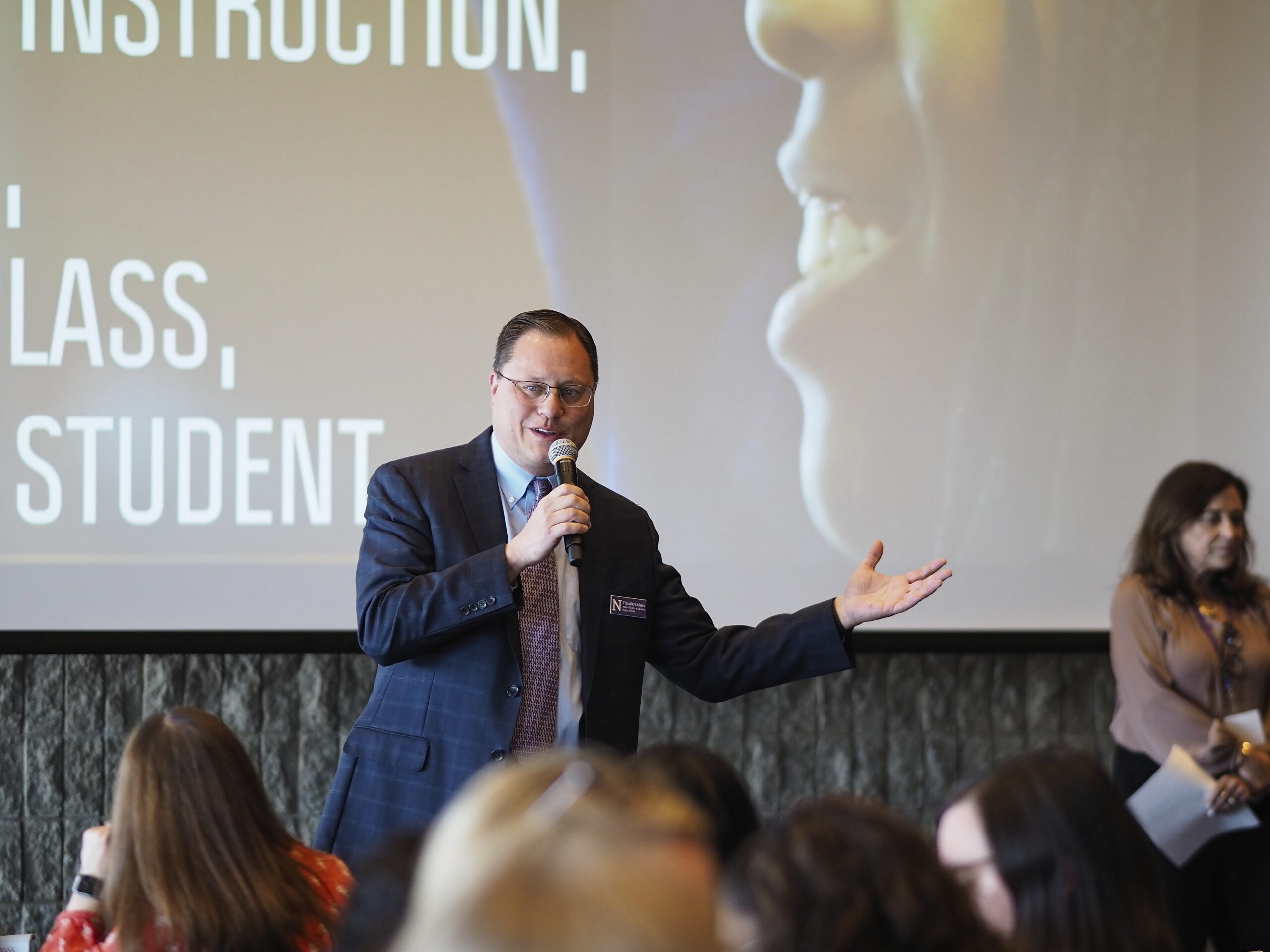
The Educational Coaching Network will specifically further our efforts around equity and opportunity as well as educator engagement and retention, and the Educational Coaching Network serves as an outstanding addition to further the coaching-centric efforts of the Illinois P-20 Network’s partner organizations at Northern Illinois University, such as NIU STEAM, the Illinois MTSS Network, and the Illinois Migrant Education Program.
With registration about to open in the coming weeks, today, you can already check out the full slate of ECN workshops coming up on our new Illinois P-20 Network Educational Coaching Network website: p20network.niu.edu/ecn
April 2023Updated PaCE Framework Webinar
Learn more about the new Middle School and updated High School PaCE Frameworks and give feedback
As required by HB3296, which was signed into law last May by Governor Pritzker and updated the Postsecondary and Workforce Readiness Act, the state educational agencies led by ISAC and including ISBE, ICCB, and IBHE, have released drafts of an updated High School PaCE Framework and a new Middle School PaCE Framework for public comment.
On Monday, March 13 at 9 AM, the Illinois P-20 Network will host a webinar providing an overview of the PaCE Framework, the updates to the High School PaCE Framework, and details regarding the Middle School PaCE Framework. This webinar is free and open to all educators across Illinois, yet it will be specifically geared for the elementary and unit school districts that have not begun to consider the PaCE Framework with the new requirements extending to grades 6-8.
High school districts are encouraged to share this learning and feedback opportunity with their sender elementary school districts. Feedback to the state educational agencies can be provided via this online PaCE Framework feedback form until March 21, 2023.
February 2023Webinar Recap – HLC Proposed Policy Changes
On February 7, 2023, Rodrigo López, Director of P-20 Initiatives at Northern Illinois University, and Aimee Galvin, Government Affairs Director at Stand for Children Illinois, hosted an informational webinar for educators across Illinois on behalf of the Illinois P-20 Network’s Dual Credit Think Tank. With attendees from across Illinois and representing school districts, community colleges, universities, and other professional and interest groups, the proposed policy changes recently communicated by the Higher Learning Commission (HLC) were shared. While the HLC proposed policy changes were the primary focus of the interview, Rodrigo and Aimee also reviewed the recent amendments to the Illinois Dual Credit Quality Act and shared the proposed rule changes to the ICCB System Rules Manual that pertain to dual credit (Section 1501.313).
View the webinar below or on the Illinois P-20 Network’s YouTube channel. Continue reading below the video for next steps.
Action Items
- If you are an HLC member institution, please consider submitting feedback on these proposed changes at this time. Learn more about HLC’s proposed revisions. Feedback by member institutions is due to HLC by February 15, 2023.
- Participate in the Dual Credit Think Tank’s next major task – Collecting and publishing best practices for reviewing the credentials and experiences of high school teachers beyond their earned academic credentials.
For more information on the Dual Credit Think Tank or to get involved, please contact Rodrigo López at rodrigo.lopez@niu.edu
Launching “KEEP Illinois – Keeping Educators Engaged Professionally”
Goal: Help solve the educator shortage by improving educator retention
Significant work is being done across Illinois by a wide variety of stakeholders, including the Northern Illinois University College of Education, to increase both the diversity and the amount of individuals in the career development pipeline to become teachers. Despite these efforts, without addressing issues of educator retention, the teacher shortage cannot be effectively resolved. To this end, the Illinois P-20 Network is taking on a statewide leadership role with regards to educator retention with the launch of KEEP Illinois – Keeping Educators Engaged Professionally.
KEEP Illinois participation is open to anyone with an interest in supporting educator retention in schools and organizations at all levels across Illinois.
Like the Illinois P-20 Network’s Dual Credit Think, KEEP Illinois seeks to build a strong grassroots base for its work by engaging practitioners from across Illinois. Additionally, over time, KEEP Illinois seeks to build formal partnerships with other organizations to further promote and implement the strategies and solutions that KEEP Illinois participants have seen work locally.
February 2023HLC Call for Feedback
Proposed Policy Changes to Assumed Practices (CRRT.B.10.020)
The Higher Learning Commission (HLC) has announced its proposed policy changes to Assumed Practices – CRRT.B.10.020. As one of six regional accreditors in the United States, these proposed changes, if approved by the Board, will help to “eliminate any restrictive impact of HLC’s requirements on student access to dual credit programs in underserved or rural areas.” Degree-granting postsecondary educational institutions in the State of Illinois, along with those located in the other 18 states, may be in a position to benefit and modify existing practices specific to the review and approval of faculty qualifications.
HLC member institutions have been requested to share feedback on these proposed changes before its formal comment process is initiated. Learn more about HLC’s proposed revisions. Feedback by member institutions is due by February 15, 2023.
The Illinois P-20 Network in collaboration with the Illinois Alliance of Concurrent Enrollment Partnerships (ILACEP) has worked with a diverse group of secondary and postsecondary educators to increase knowledge and support dual credit opportunities. As dual credit has become a critical component of schools’ early college credit programs, the Dual Credit Think Tank has focused its efforts on advocating for policies and practices that lead to an increase in the number of high school instructors teaching dual credit courses.
In June 2022, the HLC’s Board of Trustees extended the deadline for enforcement of faculty qualifications requirements in the context of dual credit education from September 1, 2023, to September 1, 2025. Institutions not in compliance with the requirements of Assumed Practice B.2.a, not only have an additional two years to get their dual credit offerings into compliance but may also have additional options with the approval of the policy changes.
Although recent amendments to the Dual Credit Quality Act have continued to address the challenges faced by dual credit programs to have more high school instructors credentialed to teach dual credit courses, revisions to HLC’s policies would make clear “that an institution can deem its faculty qualified on the basis of academic credentials, equivalent experience or some combination thereof” and that it may also “take into account substantial progress toward academic credentials in addition to achievement of such credentials” to create “parity between teaching assistants and dual credit instructors who are similarly situated in this regard.”
The Illinois P-20 Network Dual Credit Think Tank will be hosting an informational webinar on the HLC proposed policy changes to Assumed Practices – CRRT.B.10.020 on February 7, 2023, at 2 PM (CT) – Register today!
January 2023Registration Open – ISBE Career Connections Conference
ISBE Career Connections: Building Community before the IACTE Annual Conference – February 15, 2023
Join the Illinois State Board of Education (ISBE) on February 15, 2023, for a day of networking and collaboration with and among Illinois CTE educators and state administrators before attending the annual IACTE conference.
Morning sessions at the ISBE Career Connections Conference will provide timely information and support for specific groups including:
- Agriculture Grant Recipients
- Career Exploration/Career Development Experience Grant Recipients
- College and Career Pathway Coordinators
- District/School CTE Administrators
- Ed Pathway Grant Recipients
- EFE Directors
- Innovation Grant Recipients
- New or Nearly New CTE Teachers
- Regional Work Experience Career Exploration Programs
- School Counselors
Everyone is invited and encouraged to attend a specialized networking lunch and afternoon breakout sessions providing opportunities for individuals to broaden their knowledge and skillsets related to various CTE topics.
In addition, the ISBE Career Connections Conference is hosting an evening keynote event to help kick-off the IACTE Conference (February 16-17). Dr. Amanda Bastoni, Educational Research Scientist at CAST, as well as former CTE teacher and administrator, will bring her energetic and highly-informative presentation style that will provide significant insights into what schools of all sizes and in all settings across Illinois can do with and through CTE to improve learning and increase student success.
Participants have the opportunity to register for the Day Conference Event, the Keynote Dinner Event, or both events. Don’t miss this opportunity to grow your knowledge and skills while interacting with CTE colleagues from across the state. Register now for the ISBE Career Connections Conference!
And register for the 2023 IACTE Conference on February 16 and 17, 2023.
November 2022P-20 Network Meeting Explores Educator Shortage and Educator Retention
The Illinois P-20 Network hosted its Fall 2022 Meeting at NIU Naperville on Thursday, October 27, with a return to an in-person meeting for the first time since October 2019. Nearly 100 educational leaders from across Illinois were in attendance. Approximately 40% of attendees were school district leaders. 40% of attendees were postsecondary leaders, and the remaining 20% were leaders in state agencies and other professional and advocacy organizations.
The meeting began with NIU President Lisa Freeman, who shared the very personal story of her mother as a career-changing teacher in the 1960s and the impact she had on her students and their families, and Dean of the NIU College of Education Dr. Laurie Elish-Piper, who explored all the ways that educational institutions can engage and support teachers through a career pipeline from their early career exploration as middle school students through their in-service teaching and even how they can continue to support students and schools in retirement.
A series of Ignite presentations followed. Each of these presenters specifically addressed key, unique aspects of the educator shortage and/or solutions to it. The presentations included:
- Alyson Sprehe, a middle school teacher from Community Consolidated School District 21, who described how moving across all three middle schools and teaching at all three middle level grades over the course of her 25-year career has helped keep her fresh and innovating.
- Dr. Laura Hedin, department chair of Special and Early Education in the NIU College of Education, who spoke about NIU’s LEAP program, which is currently in place in both Rockford Public School District 205 and in School District U-46 and which supports practicing paraprofessionals with earning their licensure as a special education teacher while working on an accelerated timeframe.
- Bob Cofield, the director of school partnerships at Waubonsee Community College, who shared about the work that has taken place between Waubonsee, East Aurora, West Aurora, and NIU to create a modified 1+1+2 program that ensures students’ dual credit experiences in twelfth grade transfer into their degree program as education majors while also giving them a strong understanding of their work as future teachers.
- Arturo Senteno, principal at West Leyden High School, whose doctoral research has focused on the keys to teacher retention specifically for Latinx teachers. As part of this presentation Arturo provided specific recommendations for teachers and principals that should broadly help ensure high levels of performance and job satisfaction and that lead to strong retention among Latinx educators.
- Dr. Teresa Lance, assistant superintendent of equity and innovation in School District U-46, communicated six key themes for supporting teachers from diverse backgrounds in helping to lead transformative change in schools and districts. As Dr. Lance stressed, while these themes and their corresponding actions are critical for retaining teachers of color, these are also practices that all educators should employ each day.
Attendees then selected one of the following break-out sessions, in which they explored solutions to different aspects of the educator shortage and engaged in dialogue about those potential solutions. The break-out sessions were:
- Induction and Mentoring, which was led by Dr. Jodi Megerle, superintendent, and Kristy Seifert, assistant superintendent for teaching and learning, in River Trails School District 26.
- Diversification of the Teacher Workforce, which was led by Dr. Eric Junco, director of equity for the NIU College of Education.
- Supporting Dual Credit Teacher Credentialing, which was led by Anne Brennan, assistant vice president for academic affairs at Oakton Community College and by Dr. Patrick McGill, director for teaching and learning, curriculum and pathways in Glenbard School District 87.
- Avoiding Chutes out of the Profession; Building Teacher Career Ladders, led by Dr. Jason Klein, senior director of education partnerships and learning solutions at Northern Illinois University.
Finally, everyone came back together for a working lunch that featured table discussions about everything that people had heard and in which the tables identified the top three priorities to support educator retention for each of the following groups in Illinois: state government, postsecondary institutions, school districts, and the Illinois P-20 Network. At this time, the Illinois P-20 Network leadership team is organizing and analyzing the data from this activity, and the team will be publishing an action plan in an upcoming newsletter that will align to our Illinois P-20 Network Areas of Focus and lead to an updated mission statement for the Illinois P-20 Network.
October 2022Provide Feedback on CTE Standards to ISBE
ISBE wants your feedback on potential Illinois Career and Technical Education (CTE) Standards. All Illinois educators are encouraged to watch this recorded 15-minute webinar then complete this feedback survey. Links to all of the relevant elements of the webinar are below:
Draft Career Pathway Standards Documents
- Agriculture, Food, and Natural Resources
- Arts and Communications
- Finance and Business Services
- Health Sciences and Technology
- Human and Public Services
- Information Technology
- Manufacturing, Engineering, Technology, and Trades
The individual feedback survey is available to all educators in Illinois through November 6, 2022.
October 2022Register for the In-Person Fall P-20 Network Meeting
Registration is now open for the Fall 2022 P-20 Network Meeting, which will be hosted at the NIU Naperville Conference Center on October 27, 2022, from 8:30 AM to 1:00 PM. We are looking forward to gathering for a half-day of learning, conversations, and planning. The Fall Meeting will provide leaders from across the State of Illinois an opportunity to explore the root causes of today’s educator shortage as well as to learn about solutions that local institutions are putting in place to develop, recruit, retain, and diversify our educator workforce.
The 2022 Fall Meeting will feature a mix of short Ignite-style keynote speeches, a panel presentation, and breakout sessions to offer both information for leaders to take back to your own organizations as well as opportunities to discuss potential solutions and needed supports that will provide a focus for ongoing Illinois P-20 Network efforts.
The cost to attend is $35 per individual to help defray meeting costs. Lunch will be provided.
September 2022ISBE CTE Standards – Teacher Feedback Wanted
This summer, CTE educators explored the data from the CTE Industry Feedback Tour and considered it in light of identified best practices nationally in CTE in order to make recommendations regarding our need for CTE standards and supporting professional development in Illinois.
An additional opportunity for educators to provide input will take place in the format of a webinar focused on gathering feedback on options for adopting CTE Standards within the State of Illinois. Sessions will be held from 7.30 until 9 AM and 3.30 until 5 PM on September 29, 2022. Participation is open to all educators, teachers and administrators, who teach or support Career & Technical Education programs in Illinois.
The goal of this work will be to provided teachers, schools, and school districts with the tools necessary to ensure that there are high-quality and equitable CTE opportunities for all students across Illinois and for the ISBE CTE team and its partners to best support educators in meeting those goals.
Sessions will take place via Zoom and are expected to last no more than 60 minutes. Zoom links will be sent to those registered the day before each session.
If you would like to attend both sessions, we do ask that you complete the form separately for each session.
September 2022Dual Credit Think Tank Policy Brief Released
Strategies to Support Teachers in Credentialing for Dual Credit
In January 2022, the Illinois P-20 Network’s Dual Credit Think Tank launched a state-wide survey to gather examples from school districts of contract language, policies, procedures, and practices that support dual credit teacher licensure. Particularly in the face of the teacher shortage, school districts must identify new strategies to address these credentialing issues. While the recent amendment to the Illinois Dual Credit Quality Act includes an extension for teachers to secure a professional development plan which allows them to start teaching dual credit courses while they finish the minimum teaching qualifications as prescribed by the Higher Learning Commission, school districts continue to face significant challenges in supporting the necessary number of teachers in becoming credentialed to teach dual credit classes.
Additional support and resources are necessary to increase the number of teachers with dual credit credentials. Understanding school districts’ need for guidance on how they can leverage existing mechanisms, the Dual Credit Think Tank has published Strategies to Support Dual Credit Teacher Credentialing, a policy brief for educators and advocates that highlights best practices for schools to adopt in their aim to further support teachers’ journey towards meeting the minimum qualifications to teach dual credit courses. Specifically, the brief offers recommendations, based on the responses to the survey from earlier this year, on how school districts can collaborate with teachers via their collective bargaining agreements to implement financial assistance and incentives.
August 2022Summer Speaker Series Videos Online
Today, the final educator panel in this year’s Illinois State Board of Education (ISBE) CTE Summer Speaker Series was held, and now, we are pleased to share all three keynotes and all three educator panels online as resources for professional learning moving forward for educators across Illinois in Career and Technical Education (CTE) and beyond. The theme for the ISBE CTE Summer Speaker Series was CTE for ALL students and for EACH student, with a clear focus on equity and inclusion and providing support to schools to overcome barriers in order to give all students access to high quality CTE and Career and College Readiness instruction.
Each of the events listed below is linked to the corresponding YouTube video for that event. All of the YouTube videos are also organized into a single ISBE CTE Summer Speaker Series 2022 YouTube Playlist.
Family & Community Engagement and Postsecondary Placement
- Keynote – Dr. Ayanna Brown, Elmhurst University & Thought Spectrum, LLC
- Educator Panel
Active Recruitment of Special Populations into CTE Programs and Nontraditional Careers
- Keynote – Dr. Amanda Bastoni, CAST
- Educator Panel
Elimination of Barriers for Individual CTE Students
- Keynote – Dr. Valerie Milton, Michigan Department of Education
- Educator Panel
Free Administrator Academy Workshops to Kick-Off 2022-2023
As part of our Career ConneCTEd Illinois professional learning efforts, we are excited to host three online, half-day workshops at the beginning of August. Participants in these workshops can earn Professional Development Hours (PDHs) or Administrator Academy credit. Registration is free, and will close 48 hours prior to each workshop. A Zoom link and other information about each workshop will be sent to participants 48 hours ahead of each workshop. Each workshop will take place from 9 AM until noon.
- August 3 – Social and Emotional Learning Leads to College and Career Readiness – Register
- August 4 – PaCE Framework Overview – Register
- August 5 – Illinois Career Pathways Overview – Register
