

Dual Credit Think Tank – Legislative Priorities Survey Update
This week, the Dual Credit Think Tank met and reviewed the data that resulted from the Legislative Priorities Survey that was launched following the August 1 Legislative Update Webinar. The survey sought to identify which topics related to HB5020 were most important to the field. Once those topics were identified, the goal would be to relaunch dialogue on these topics among interested and diverse groups of practitioners from school districts and postsecondary institutions to try to arrive at compromise and consensus.
During this week’s Dual Credit Think Tank meetings, participants collaborative analyzed the data. They sought to identify what patterns emerged in the data and which topics respondents felt were most important for further discussion (including identification of the evidence that supported these topics).
As this Newsletter goes out, the Illinois P-20 Network team is reviewing the responses from Dual Credit Think Tank participants and identifying action steps, which will be communicated to Think Tank participants in the coming weeks. To stay up-to-date on what is taking place with the Dual Credit Think Tank, please visit the Illinois P-20 Network’s Dual Credit Think Tank website and watch for upcoming Illinois P-20 Network Newsletters.
October 2024Important Dual Credit Think Tank Survey Seeking Responses
This summer, the Dual Credit Think Tank consistently engaged in work following the legislative session based on the goings-on with HB5020, including June and July meetings that identified topics and questions for legislators, and the Legislative Webinar on August 1.
Now, a survey regarding dual credit has been developed based on not only the August 1 webinar but also the conversations that took place during the June and July Think Tank meetings. This survey has two key purposes:
- The results of this survey will inform communications from the Dual Credit Think Tank to policymakers about what is important to the field, both school districts and postsecondary institutions, for continued efforts around HB5020 or around new legislative proposals.
- The results of this survey will also inform the Illinois P-20 Network for developing time-sensitive and needed professional learning opportunities to support school districts, postsecondary institutions, and regions with their efforts to develop dual credit programming for students.
While the survey is anonymous, we optionally request that participants complete the final section with your organization’s information. In that event, survey responses will still be kept confidential, but this additional data will allow us to engage in more detailed and complex analyses that include demographic and funding data from other sources.
Please complete this survey by Friday, September 6, 2024, and please share the link to the survey widely with other school districts and postsecondary institutions. We hope to have responses from organizations in communities throughout the state.
August 2024HB5020 Update – Next Steps in the Senate
At the time of this posting, HB5020 has made no movement through the Illinois Senate’s Assignments Committee or towards a floor vote in the Senate. Questions have appeared to emerge about whether this bill will move forward through the legislative process, and Illinois P-20 Network partners are asking questions about how they can impact the legislation.
As we have previously written on this topic, the Illinois P-20 Network takes no position on HB5020 itself. We do believe that well-designed dual credit coursework is one component of a high-quality and equitable approach to career and college readiness. Additionally, the Illinois P-20 Network continues to commit to:
- Share updates to the Dual Credit Think Tank, specifically, and to the field broadly.
- Provide opportunities for practitioners from both postsecondary institutions and school districts to share their feedback on key elements of discussion that are still being considered with the next amendment to HB5020.
In a previous post, the Illinois P-20 Network has explained how to file a witness slip for a committee. In addition to that, on this or any other bill (or any topic more broadly), educators can and should contact their elected officials in the General Assembly that represent the district(s) in which their organization resides as well as the elected officials that represent their personal residence.
Phone calls and emails that detail your experience and explain the impact of potential legislation are most helpful. Included concrete and verifiable data not only provides greater veracity to your arguments, but better substantiates your expertise in the field and should improve the overall quality of the legislative debate.
Continue to check on the Illinois P-20 Network News feed for updates on HB5020.
May 2024HB5020 Update – Amendment 002
Update 3 – 12 PM – 17 April 2024 – This morning, the Higher Education Committee met and heard Amendment 002. HB5020 passed unanimously from the Committee, and the bill will now head to the House floor in its current form.
Update 2 – 3.45 PM – 16 April 2024 – The update below proved to be incorrect. The amendment was not able to be fully filed through General Assembly processes in time for today’s Higher Education Committee hearing. The full text of Amendment 002 is now posted on the General Assembly website. The Amendment will now be heard at a 10.30 AM Higher Education Committee hearing tomorrow, Wednesday, April 17, 2024. Witness Slips specifically for Amendment 002 can be filed at this Amendment 002 Witness Slip link. For directions on how (and why) to file a Witness Slip, check out this previous HB5020 News post on the Illinois P-20 Network website.
Update – 3 PM – 15 April 2024 – As we understand it, and while it has not yet been confirmed with posting on the General Assembly’s website, the Higher Education Committee will hear Amendment 002 to HB5020 at 11 AM on Tuesday, April 16, 2024.
HB5020 is an amendment to the Illinois Dual Credit Quality Act, and throughout this legislative process, the Illinois P-20 Network remains committed to:
- Share updates to the Dual Credit Think Tank, specifically, and to the field broadly.
- Provide opportunities for practitioners from both postsecondary institutions and school districts to share their feedback on key elements of discussion that are still being considered with the next amendment to HB5020.
As stated in last week’s update following the April 3, 2024, hearing of the Higher Education Committee, work continued with key stakeholders on an additional amendment. A range of parties have agreed to updated components of the legislation (outlined below) that will be included in Amendment 002, which is currently being officially drafted by the General Assembly’s Legislative Reference Bureau (LRB). Once posted by the LRB, the bill will return to the Higher Education Committee for another hearing, which is expected to be early next week. If approved by the Committee, the bill will then be up for a floor debate in the Illinois General Assembly House of Representatives. This floor debate must also take place next week, and as a result, it is expected that the HB5020 with Amendment 002 will, once again, be called before the Higher Education Committee early next week.
As the process evolves, anyone can view updates to the status of HB5020 on the Illinois General Assembly’s website. Additionally, the Illinois P-20 Network will continue to provide updates as quickly as possible to members of the Dual Credit Think Tank as well as posting News updates on our website and communicating via the every-other-week Illinois P-20 Network Newsletter.
Amendment 002 completely replaces Amendment 001, and this is referred to as a gut and replace. As of this posting, key components of the legislation include: (Please note that items below that new or updated elements from Amendment 002 have been noted in-text.)
Amendment 002 defines fully-qualified instructors as instructors who either a) meet the academic credentials which are defined as a master’s degree within the discipline to be taught or any master’s degree and not more than 18 graduate hours in the discipline to be taught; or b) is a career and technical education (CTE) instructor who meets the equivalent experience that is commensurate with achievement of academic credentials, as defined by the Dual Credit Instructor Qualification Framework. This is a new addition to the legislation in Amendment 002.
Amendment 002 defines minimally qualified instructors as instructors who are enrolled in a Professional Development Plan and either (a) have a master’s degree in any discipline and have completed a minimum of 9 hours of the graduate coursework requirements of the Dual Credit Instructor Qualification Framework for the course; or, (b) are a fully licensed CTE instructor who is halfway toward meeting the required equivalent experience criteria defined by the Dual Credit Instructor Qualification Framework. This is a new addition to the legislation in Amendment 002.
Amendment 002 expands the purpose of the Dual Credit Quality Act (DCQA) to emphasize the importance of collaborative local partnerships to provide meaningful dual credit opportunities to students and close opportunity gaps.
Amendment 002 requires school districts and community colleges to each designate a liaison and begin partnership negotiations within 60 calendar days of the school district’s initial request.
Amendment 002 offers parity in Priority Career Pathway courses with Illinois Articulation Initiative course offerings to expand opportunities for students for Priority Career Pathways that already exist at the community college.
Amendment 002 uses the standards established by the Developmental Education Reform Act (DERA) for student eligibility measures that recognize a broader range of student achievement, and ICCB will begin collecting data on what multiple measures are being used.
Amendment 002 requires clear communication plans and advanced notice for students and families, so they understand opportunities for early college credit and the necessary prerequisites.
Amendment 002 stipulates that course evaluations should occur within the same school year the course is taught to maintain rigorous standards.
Amendment 002 requires community college districts to reinvest revenues received from school districts for dual credit programming back into dual credit programming.
Amendment 002 allows high schools to use their district policies to determine class size, student technology access, and student accommodations if the course is taught by high school instructors at the high school and only if these policies do not interfere with rigorous student learning outcomes. Amendment 002 does stipulate that these district policies may not interfere with rigorous student learning outcomes. The language around this provision has been updated in Amendment 002.
Amendment 002 allows high schools to coordinate with their higher learning partner to determine course length and number of sections an individual instructor may teach for courses taught by high school instructors at the high school to ensure maximum student access while maintaining rigorous student learning outcomes.
Amendment 002 empowers school districts to offer dual credit courses equal weight with Advanced Placement and International Baccalaureate courses. This is updated language in Amendment 002, in which “districts shall equally weight” from the original HB5020 text was changed to “districts may equally weight.”
Amendment 002 provides that if a community college disapproves of a course request…
- Creates a mechanism within ICCB to review instructor credential denials, which provides another avenue to resolve disputes between a high school and community college and keep more courses available through local partnerships rather than alternative providers.
- Allows high schools to engage an alternative provider for a particular course if their partnering community college disapproves of that course request.
- Permits a community college to reevaluate the course request annually to approve the course and offer the course as originally proposed.
Amendment 002 prohibits dual credit partnerships with for-profit postsecondary institutions.
Amendment 002 codifies the right of community colleges to have first refusal with local partnerships.
Amendment 002 requires all institutions (4-year, 2-year, public, private, in-state, out-of-state) offering dual credit to follow the elements of a dual credit partnership agreement established in section 16 of the Dual Credit Quality Act.
Amendment 002 further limits the use of out-of-state providers by requiring high schools to demonstrate to the IBHE that it has taken appropriate steps to use in-state institutions and must provide rationale if using an out-of-state institution.
Amendment 002 requires IBHE to publish a list of partnership agreements with both out-of-state and private institutions. The update in Amendment 002 adds private institution to this language.
Amendment 002 reconvenes the Model Partnership Agreement Committee biennially.
Amendment 002 defines “academic credentials” as master’s degree within the discipline to be taught or any master’s degree and not more than 18 graduate hours in the discipline to be taught.
Amendment 002 extends professional development plans in perpetuity to address the ongoing teacher shortage and growing student demand for dual credit coursework.
Amendment 002 strikes language allowing instructors with only a bachelor’s degree to enter a Professional Development Plan. This is a change in Amendment 002 from the previous versions of HB5020.
Amendment 002 entrusts the annual course review to the higher learning partner’s faculty department chair and the chief academic officer (or their designees).
Amendment 002 charges ICCB to conduct a study to examine the long-term and short-term outcomes for differing dual credit hour attainment. This is a new addition to HB5020 in Amendment 002.
Amendment 002 creates the Dual Credit Committee, a 29-member committee of secondary and postsecondary representatives to define two specific components: (1) the appropriate graduate coursework within disciplines covered by the Illinois Articulation Initiative (IAI) for academically qualified and interim qualified instructors; and, (2) the equivalent experience required to be a fully qualified CTE instructor.
April 2024HB5020 Update
An update on developments with HB 5020 in Springfield today
On April 3, 2024, the Higher Education Committee held a hearing and among the bills heard was HB5020, an amendment to the Dual Credit Quality Act. Multiple people representing interest groups testified and shared their positions, and ultimately, there was a commitment to continue negotiations on an additional amendment to the legislation that is currently being drafted with additional stakeholder feedback. The Illinois P-20 Network will continue to do two things as this process moves forward:
- Share updates to the Dual Credit Think Tank, specifically, and to the field broadly.
- Provide opportunities for practitioners from both postsecondary institutions and school districts to share their feedback on key elements of discussion that are still being considered with the next amendment to HB5020.
Once the amendment in development is complete, HB5020 will come back to the Higher Education Committee for review.
As a reminder, through the legislative process, there may be changes to items listed below. This list simply captures key elements of HB5020 that have been agreed upon at this time. HB5020…
- Expands the purpose of the Dual Credit Quality Act (DCQA) to emphasize the importance of collaborative local partnerships to provide meaningful dual credit opportunities to students and close opportunity gaps.
- Requires school districts and community colleges to each designate a liaison and begin partnership negotiations within 60 calendar days of the high school’s initial request.
- Offers parity in Priority Career Pathway courses with Illinois Articulation Initiative course offerings to expand opportunities for students for Priority Career Pathways that already exist at the community college.
- Uses the standards established by the Developmental Education Reform Act (DERA) for student eligibility measures that recognize a broader range of student achievement, and ICCB will begin collecting data on what multiple measures are being used.
- Requires clear communication plans and advanced notice for students and families so they understand opportunities for early college credit and the necessary prerequisites.
- Stipulates that course evaluations should occur within the same school year the course is taught to maintain rigorous standards.
- Requires community college districts to reinvest revenues received from school districts for dual credit programming back into dual credit programming.
- Offers dual credit courses equal weight with Advanced Placement and International Baccalaureate courses.
- Prohibits dual credit partnerships with for-profit institutions.
- Codifies the community college’s right of first refusal.
- Requires all institutions (4-year, 2-year, public, private, in-state, out-of-state) offering dual credit to follow the elements of a dual credit partnership agreement established in section 16 of the DCQA.
- Further limits the use of out-of-state providers by requiring high schools to demonstrate to the IBHE that it has taken appropriate steps to use in-state institutions and must provide rationale if using an out-of-state institution.
- Reconvenes the Model Partnership Agreement Committee biennially.
- Defines academic credentials as master’s degree within the discipline to be taught or any master’s degree and not more than 18 graduate hours in the discipline to be taught.
- Extends professional development plans in perpetuity to address the ongoing teacher shortage and growing student demand for dual credit coursework.
- Entrusts the annual course review to the higher learning partner’s faculty department chair and the chief academic officer (or their designees).
- Creates the Dual Credit Committee, a 29-member committee of secondary and postsecondary representatives to define two specific components: (1) the appropriate graduate coursework within disciplines covered by the Illinois Articulation Initiative (IAI) for academically qualified and interim qualified instructors; and, (2) the equivalent experience required to be a fully qualified Career and Technical Education instructor.
- If a community college disapproves of a course request…
- Creates a mechanism within ICCB to review instructor credential denials, which provides another avenue to resolve disputes between a high school and community college and keep more courses available through local partnerships rather than alternative providers.
- Allows high schools to engage an alternative provider for a particular course if their partnering community college disapproves of that course request.
- Permits a community college to reevaluate the course request annually to approve the course and offer the course as originally proposed.
In addition to the updates that are being provided by the Illinois P-20 Network, anyone can view the current text of HB5020 as well as its current status on the Illinois General Assembly website.
April 2024HB5020 – Share your expertise | Impact the process
UPDATE – 21-March-2024 – 11.05 AM – The Illinois P-20 Network understands that HB5020 will no longer be called before the Higher Education Committee later today. Rather, additional work is likely to take place with various stakeholders as a next step. As the Illinois P-20 Network receives additional updates, those will be communicated to the Dual Credit Think Tank and to the field. Additionally, throughout this process, the Illinois P-20 Network will continue to engage and encourage the involvement of educators from both school districts and postsecondary institutions to put into place the best possible solutions for our collective students.
Tomorrow, Thursday, March 21, 2024, at 4 PM, HB5020 (See this previous HB5020 post for more information) is scheduled for a hearing with the Higher Education Committee. In advance of this, educators and other members of the public can file witness slips to share their expertise and to impact the legislative process. Witness slips allow members of the public to file in support of a bill, in opposition of a bill, or one can even file a neutral witness slip.
The purpose of sharing this is two-fold. First, dual credit is one critical element of our focus on Career and College Readiness, and the Dual Credit Think Tank has been actively working in this area for over four years alongside ILACEP and other key stakeholders who seek to improve dual enrollment and early college opportunities for students. The Illinois P-20 Network takes no position in favor of or in opposition to HB5020. Rather, our primary objective in sharing this is to ensure that practitioners impact policy outcomes.
One critical function of the Illinois P-20 Network is to ensure that the voices of practicing educators are able to be part of legislative and policymaking processes in order to support our goal of implementing engaging and effective assessment and instructional strategies for all learners.
To complete a witness slip, visit the Illinois General Assembly’s HB5020 web page, and follow the steps listed below. Again, a witness slip can and should be completed any time up to when the hearing ends, and it is a critical way for the expert voices of educators to influence the policymaking process.
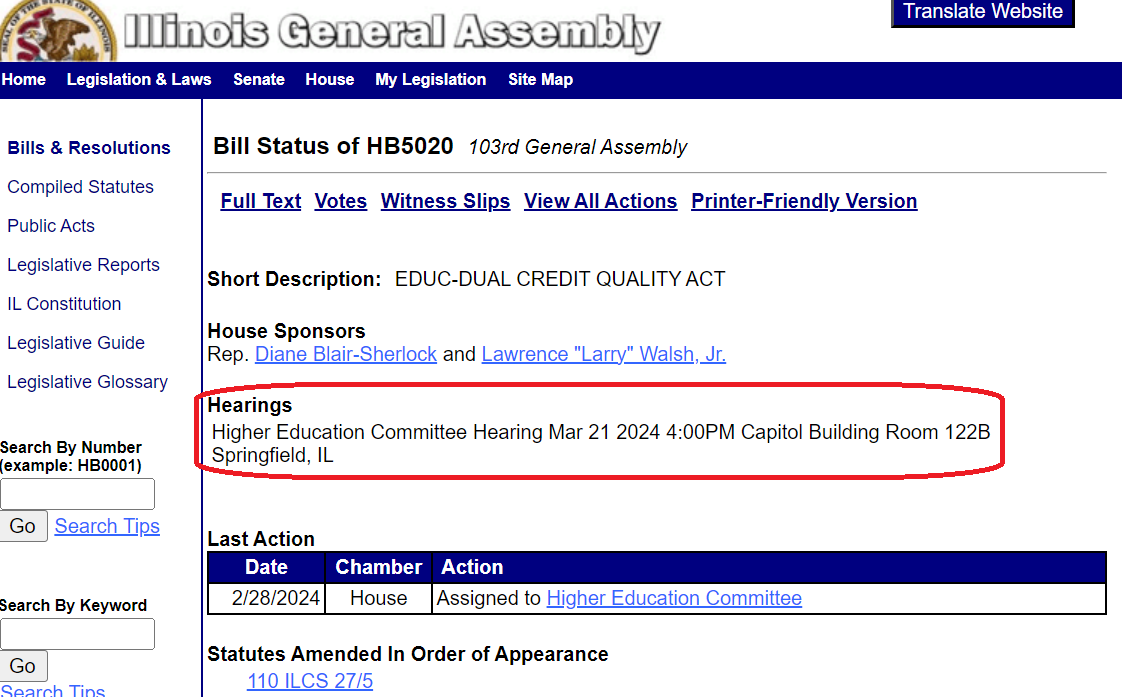
When you first are on the General Assembly’s web page for a specific piece of legislation, you will notice that you have access near the top of the page to the full text of the legislation. Additionally, any sponsors of the legislation are listed, and just below that, highlighted in the image below, any upcoming hearings for this piece of legislation are also listed.
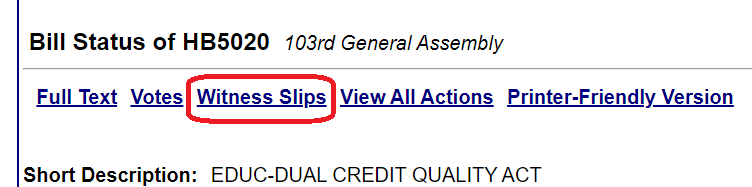
There are a series of steps that a user needs to click through in order to actually create a witness slip. These apply not only to HB5020 but to all bills introduced in the Illinois General Assembly. The first step is to click the “Witness Slips” link near the top of the page.
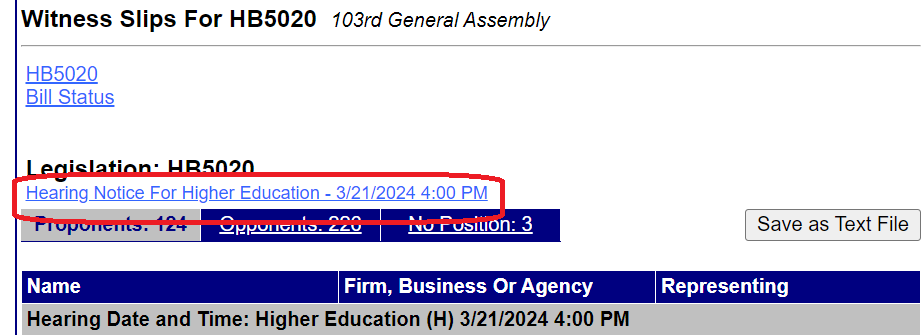
On the next page that loads, you can see who has issued witness slips in support of the bill, in opposition to the bill, and with no position. Near the top of this page, there is a link that you should click on to continue to move through the process to create your own witness slip.
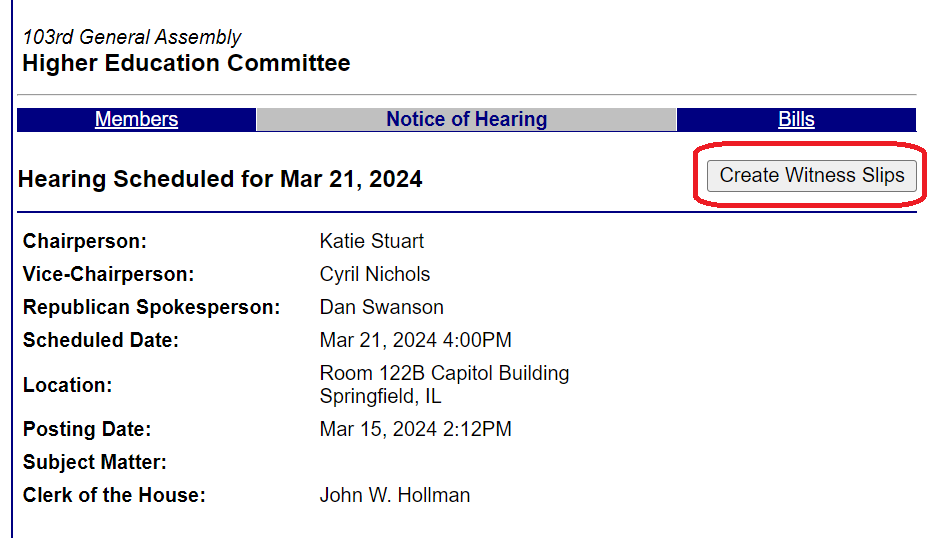
On the next page, click the “Create Witness Slips” button on the right side of the web page as pictured below.
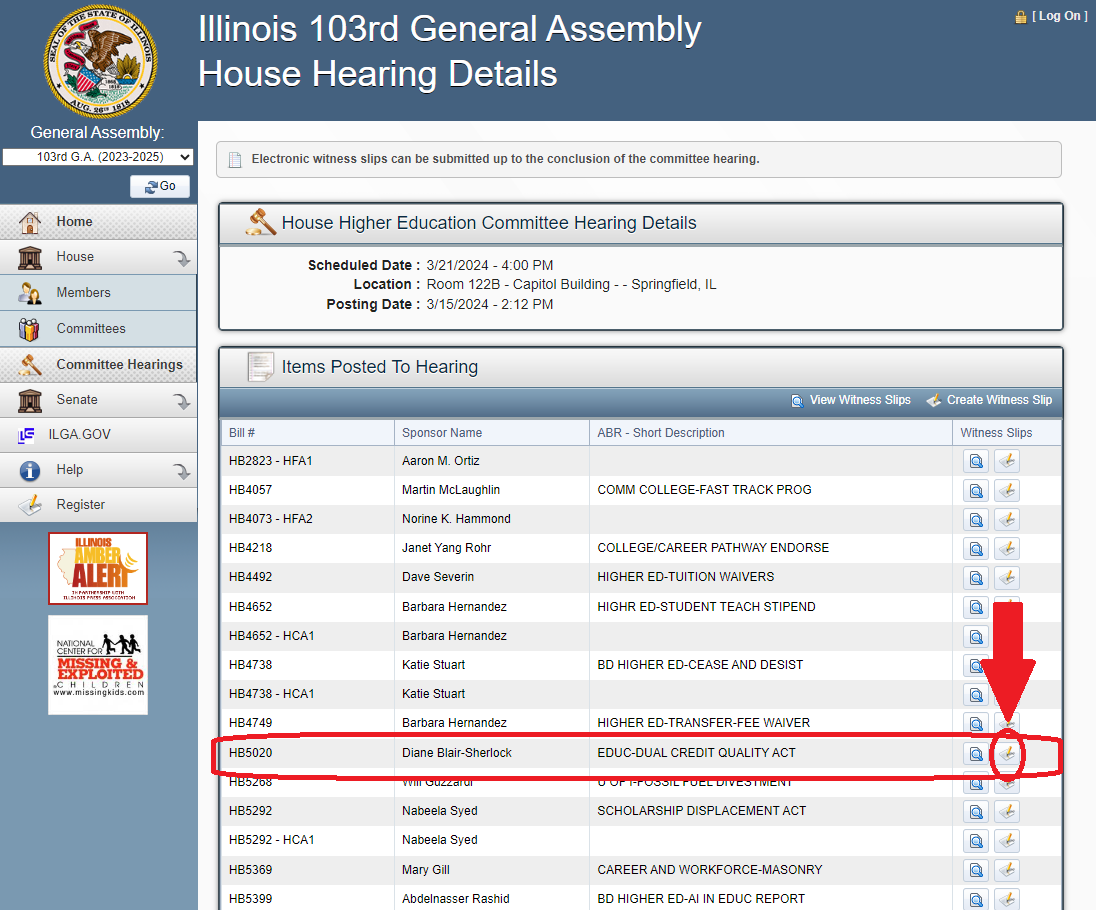
Now, a completely new website will load in your browser with an entirely different appearance. On this page, you need to find the bill on which you want to leave a witness slip. Once you have identified that bill’s row, you will click the icon on the far right of the row to create your own witness slip. (That button is circled in the image below.)
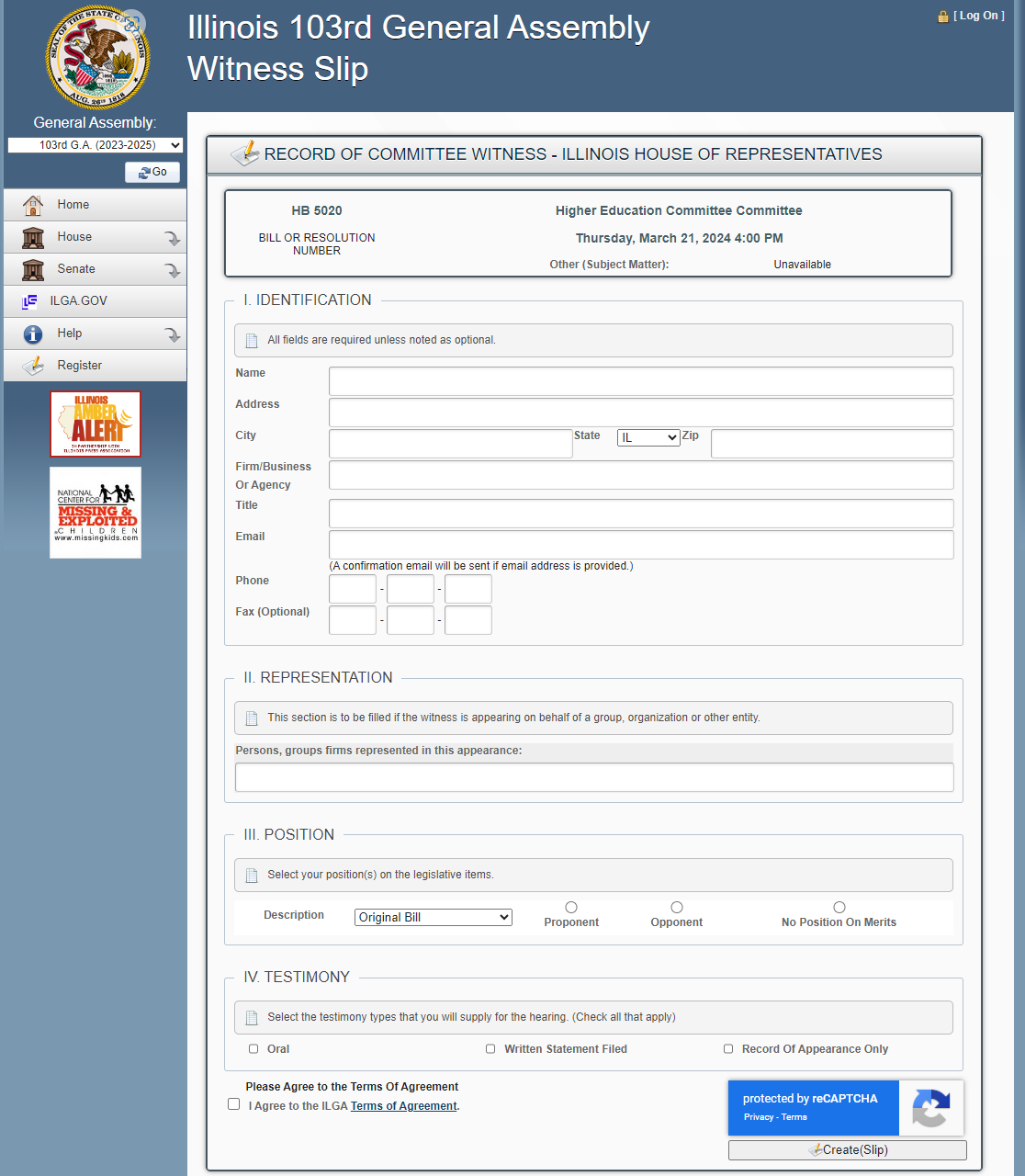
The Witness Slip form will now open. Complete this entire form. Be sure to provide your context and expertise. If you have data, include that data (while, obviously, protecting the privacy of personally identifiable information). Before you can submit, you do need to check the checkbox in the lower left corner in order to agree to the terms of the site before you can submit.
Factsheet Released on Proposed Amendment to the Dual Credit Quality Act
Stand for Children Illinois has released a two-page summary factsheet of House Bill 5020. This document provides information on student enrollment gaps across different demographic groups as well as highlights the pace at which dual credit continues to grow.
More importantly, the factsheet provides a quick summary of the proposed amendment to the Dual Credit Quality Act. This includes:
- Multiple measures for student eligibility and increased communication with families.
- Statewide framework for minimum qualifications to teach (per the new HLC guidelines).
- Guidance on partnering with alternative postsecondary institutions.
The Illinois P-20 Network’s Dual Credit Think Tank will continue to collect feedback from educators across Illinois from both school districts and postsecondary institutions throughout the process.
If you have any questions or comments, please feel free to contact Rodrigo López, Director of P-20 Initiatives (rodrigo.lopez@niu.edu).
March 2024An Overview Webinar of HLC’s Proposed Policy Changes
On September 6, 2023, Rodrigo López, Director of P-20 Initiatives at Northern Illinois University, and Aimee Galvin, Government Affairs Director at Stand for Children Illinois, hosted an informational webinar for educators across Illinois on behalf of the Illinois P-20 Network’s Dual Credit Think Tank.
With attendees from across Illinois representing secondary and postsecondary institutions, Rodrigo and Aimee reviewed the Higher Learning Commission’s (HLC) proposed policy changes to Faculty Qualifications, resulting from the HLC’s Board of Trustees’ first reading of the policy this past summer. The Board is expected to vote on the proposed Faculty Qualifications policy during their upcoming meeting this November.
The webinar provided background context to these proposed policy changes, and the webinar also provided information on the current policy and guidelines (Determining Qualified Faculty Through HLC’s Criteria for Accreditation and Assumed Practices) as noted in the Assumed Practices – CRRT.B.10.020. Aimee from Stand for Children Illinois offered an overview of their organization’s philosophy on dual credit and shared some thoughts on potential implications for both school districts and postsecondary institutions in Illinois, which are included in the Stand for Children Illinois HLC Proposed Rule Change Comment Letter.
Next Steps for Practitioners to Consider (and for Action)
The proposed policy changes and the information shared by the Dual Credit Think Tank present a time-sensitive opportunity for both school districts and postsecondary institutions to engage in a conversation about how these changes may impact their goals and their directions moving forward. For example, the HLC is seeking to adopt Progress toward academic credentials as an alternative to approve instructors to teach college courses. In the context of dual credit, this allows dual credit partnerships to construct a framework to explore the use of Professional Development Plans as a means to be credentialed to teach dual credit courses, similar to what is described in the Dual Credit Quality Act. Additionally, Illinois P-20 Network partners might find value in learning more about implementing a local policy that uses Equivalent Experience to increase dual credit instructors within career and technical education.
Understanding that dual credit partnerships from across Illinois face their own unique challenges, the Dual Credit Think Tank encourages all members to critically analyze the proposed policy changes and participate in the open comment period.
Please note that comments to HLC regarding this proposed policy change remain open through September 18, 2023. Comments can be provided to HLC via email: policycomments@hlcommission.org
The full webinar can be viewed on YouTube or below.
Webinar Recap – HLC Proposed Policy Changes
On February 7, 2023, Rodrigo López, Director of P-20 Initiatives at Northern Illinois University, and Aimee Galvin, Government Affairs Director at Stand for Children Illinois, hosted an informational webinar for educators across Illinois on behalf of the Illinois P-20 Network’s Dual Credit Think Tank. With attendees from across Illinois and representing school districts, community colleges, universities, and other professional and interest groups, the proposed policy changes recently communicated by the Higher Learning Commission (HLC) were shared. While the HLC proposed policy changes were the primary focus of the interview, Rodrigo and Aimee also reviewed the recent amendments to the Illinois Dual Credit Quality Act and shared the proposed rule changes to the ICCB System Rules Manual that pertain to dual credit (Section 1501.313).
View the webinar below or on the Illinois P-20 Network’s YouTube channel. Continue reading below the video for next steps.
Action Items
- If you are an HLC member institution, please consider submitting feedback on these proposed changes at this time. Learn more about HLC’s proposed revisions. Feedback by member institutions is due to HLC by February 15, 2023.
- Participate in the Dual Credit Think Tank’s next major task – Collecting and publishing best practices for reviewing the credentials and experiences of high school teachers beyond their earned academic credentials.
For more information on the Dual Credit Think Tank or to get involved, please contact Rodrigo López at rodrigo.lopez@niu.edu
