

SkillsUSA Illinois Apprenticeship & Work-Based Learning Landscape Analysis Webinar
Update – 2025-March-07 – We are excited to have publish Constructing a Strong Foundation on which to Build: SkillsUSA Illinois Apprenticeship and Work-Based Learning Landscape Analysis.
With the support of SkillsUSA Illinois, throughout the Fall and Winter of the 2024-2025 year, a research team from the NIU P-20 Research and Data Collaborative comprised of the Illinois P-20 Network and the Workforce Policy Lab at the NIU Center for Governmental Studies has conducted a comprehensive overview of apprenticeship programs across Illinois, including their locations, the career fields they cover, and the demographics of current apprentices. This work has also focused on Work-Based Learning more broadly, including paid and unpaid internships. To complete this study, the team brought together existing governmental data sources from the United States Department of Labor and the Illinois State Board of Education as well as seeking input from both educators (school districts and postsecondary) and from business and community partners with two original surveys.
On Thursday, March 13, 2025, we will be hosting a webinar for educators to provide an overview of the results, the key themes, and the report’s recommendations. As a landscape analysis, this report is simply a starting point for future work, though we are both excited to have helped start moving Illinois further down the road of thoughtful data analysis as well as thankful for the support of SkillsUSA Illinois that allowed this work to take place.
March 2025The Road to Retention KEEP Illinois Report Released
This week, KEEP Illinois met to review the now released report, The Road to Retention: Understanding the educator shortage and ways to engage and keep educators. This report reviews the existing literature on educator retention and engagement as well as state and national data. The report also makes recommendations regarding both policies and practices that can enhance educator engagement (and, ultimately, retention).
During the KEEP Illinois meetings, participants discussed which recommendations should be priorities as well as which are most realistic. Following those discussions, KEEP Illinois participants will receive a short follow-up survey. Based on those survey results and the discussions, a KEEP Illinois action plan will be put into place and future efforts will focus on implementing policies and practices across Illinois that are likely to increase engagement for all educators so they can continue to thrive throughout their careers. The video included below provides a brief overview of the full report.
To stay up-to-date on what is taking place with KEEP Illinois, please visit the Illinois P-20 Network’s KEEP Illinois website and watch for upcoming Illinois P-20 Network Newsletters.
October 2024Dual Credit Think Tank – Legislative Priorities Survey Update
This week, the Dual Credit Think Tank met and reviewed the data that resulted from the Legislative Priorities Survey that was launched following the August 1 Legislative Update Webinar. The survey sought to identify which topics related to HB5020 were most important to the field. Once those topics were identified, the goal would be to relaunch dialogue on these topics among interested and diverse groups of practitioners from school districts and postsecondary institutions to try to arrive at compromise and consensus.
During this week’s Dual Credit Think Tank meetings, participants collaborative analyzed the data. They sought to identify what patterns emerged in the data and which topics respondents felt were most important for further discussion (including identification of the evidence that supported these topics).
As this Newsletter goes out, the Illinois P-20 Network team is reviewing the responses from Dual Credit Think Tank participants and identifying action steps, which will be communicated to Think Tank participants in the coming weeks. To stay up-to-date on what is taking place with the Dual Credit Think Tank, please visit the Illinois P-20 Network’s Dual Credit Think Tank website and watch for upcoming Illinois P-20 Network Newsletters.
October 2024Important Dual Credit Think Tank Survey Seeking Responses
This summer, the Dual Credit Think Tank consistently engaged in work following the legislative session based on the goings-on with HB5020, including June and July meetings that identified topics and questions for legislators, and the Legislative Webinar on August 1.
Now, a survey regarding dual credit has been developed based on not only the August 1 webinar but also the conversations that took place during the June and July Think Tank meetings. This survey has two key purposes:
- The results of this survey will inform communications from the Dual Credit Think Tank to policymakers about what is important to the field, both school districts and postsecondary institutions, for continued efforts around HB5020 or around new legislative proposals.
- The results of this survey will also inform the Illinois P-20 Network for developing time-sensitive and needed professional learning opportunities to support school districts, postsecondary institutions, and regions with their efforts to develop dual credit programming for students.
While the survey is anonymous, we optionally request that participants complete the final section with your organization’s information. In that event, survey responses will still be kept confidential, but this additional data will allow us to engage in more detailed and complex analyses that include demographic and funding data from other sources.
Please complete this survey by Friday, September 6, 2024, and please share the link to the survey widely with other school districts and postsecondary institutions. We hope to have responses from organizations in communities throughout the state.
August 2024Checking in on HB5020 and Dual Credit Legislation
On August 1, 2024, the Illinois P-20 Network’s Dual Credit Think Tank held a meeting that featured a panel to discuss HB5020, the legislative process, and the current and future state of a possible amendment to the Dual Credit Quality Act. Panelists included Representative Diane Blair-Sherlock, the representative for Illinois’ 46th District in the House and the sponsor of HB5020; Aimee Galvin of Stand for Children Illinois, who led the original writing of HB5020 and who continued to engage in negotiations throughout the legislative session; and, Bobby Johnson, a staff member for the Senate Democrats and the staffer who is responsible for the Senate’s Higher Education Committee. Senator Cristina Castro, who sponsored HB5020 in the Senate, was invited to attend and had planned to attend until approximately one week before the meeting when she notified the Illinois P-20 Network of a conflict and was able to secure Mr. Johnson in her place.
The meeting focused on key questions that had been identified by Dual Credit Think Tank members at the June and July meetings. Topics covered included:
- An overview of key elements of HB5020 from the perspective of each of the panelists
- The current status of HB5020
- Likely next steps for HB5020 and/or other future legislation related to dual credit in Illinois
- Teacher credentialing for high school teachers teaching dual credit
- Ability of school districts to partner with postsecondary institutions other than their own community college
- Reference to school districts’ progress to offer College and Career Pathway Endorsements (i.e., requires six credit hours of early college credit) and the need for continued alterations to dual credit policy in Illinois
- Research into the long-term impact of dual credit within and across Illinois
- Potential funding to specifically support dual credit across Illinois, particularly given funding to support Advanced Placement
Representative Blair-Sherlock stressed that this bill went through multiple revisions in the House before ultimately being passed on to the Senate. She pointed out that through the negotiation process around these revisions, key stakeholders and interest groups expressed that, at the time of the floor vote by the full House, they were either in support of the bill or neutral on HB5020. She also expressed frustration that, though it moved into the Senate with overwhelming bipartisan support, at that point new issues appeared to pop up, and the bill became stuck in the Senate’s Rules Committee without even receiving a hearing.
Mr. Johnson identified three key disagreements that remained among interest groups as he understood it. The two smaller issues were conversations about who dictated class size limits (the school district or the postsecondary institution) and the right to refusal as it relates to partnering with only the school district’s local community college. The third, and more significant issue, that Mr. Johnson identified was the education and/or work requirements for a high school teacher to be credentialed as a dual credit teacher. On this point, both the panelists and participants stressed that many postsecondary faculty members feel that this teacher credentialing is the key to ensuring high-quality instructional experiences and to maintaining the same rigor that is in place in the postsecondary setting, which is key to meaningful dual credit offerings.
In addition to the panelists and over 70 attendees, representatives from both the Illinois Community College Board (ICCB) and Illinois State Board of Education (ISBE) were in attendance. Among those statewide leaders was ICCB Executive Director Brian Durham, who spoke about ICCB’s ongoing involvement in continued conversations about HB5020 with community college presidents as well as through a recent meeting ICCB convened with a small group of school district superintendents and community college presidents on the topic. From ICCB’s perspective, there is an ongoing commitment to continuing to negotiate with key stakeholders and this commitment is shared with community college presidents from across Illinois.
While there is much work to continue being done, the meeting concluded with the following key points:
- There is a commitment to addressing teacher credentialing and the professional development plans further, particularly considering the Higher Learning Commission (HLC) policy change last November, whether through HB5020 as early as this fall’s Veto Session or through a new bill.
- There would likely be strong support in examining funding around dual credit, particularly given the support of Advanced Placement, though it was recommended that this would be most effectively approached through separate legislation after the passage of some form of the currently proposed legislation that addresses teacher credentialing.
Though it is not entirely clear how, when, or who will lead these next steps, the Dual Credit Think Tank will continue to fulfill its role in providing a forum for the practitioners doing the work to better understand policymaking processes and share their expert thoughts and experiences throughout the process.
If you are not currently a member of the Dual Credit Think Tank and you are interested in participating, please complete this short Dual Credit Think Tank New Member Form.
August 2024HB5020 Update – Next Steps in the Senate
At the time of this posting, HB5020 has made no movement through the Illinois Senate’s Assignments Committee or towards a floor vote in the Senate. Questions have appeared to emerge about whether this bill will move forward through the legislative process, and Illinois P-20 Network partners are asking questions about how they can impact the legislation.
As we have previously written on this topic, the Illinois P-20 Network takes no position on HB5020 itself. We do believe that well-designed dual credit coursework is one component of a high-quality and equitable approach to career and college readiness. Additionally, the Illinois P-20 Network continues to commit to:
- Share updates to the Dual Credit Think Tank, specifically, and to the field broadly.
- Provide opportunities for practitioners from both postsecondary institutions and school districts to share their feedback on key elements of discussion that are still being considered with the next amendment to HB5020.
In a previous post, the Illinois P-20 Network has explained how to file a witness slip for a committee. In addition to that, on this or any other bill (or any topic more broadly), educators can and should contact their elected officials in the General Assembly that represent the district(s) in which their organization resides as well as the elected officials that represent their personal residence.
Phone calls and emails that detail your experience and explain the impact of potential legislation are most helpful. Included concrete and verifiable data not only provides greater veracity to your arguments, but better substantiates your expertise in the field and should improve the overall quality of the legislative debate.
Continue to check on the Illinois P-20 Network News feed for updates on HB5020.
May 2024HB5020 Update – To the Senate
As we continue to work to provide accurate and detailed updates to the field regarding HB5020 (previous updates here and here and here and here), we wanted to share that yesterday evening, Thursday, April 18, 2024, the Illinois House of Representatives overwhelmingly (and possibly unanimously) passed HB5020. It will now move to the Senate for consideration.
April 2024HB5020 Update – Amendment 002
Update 3 – 12 PM – 17 April 2024 – This morning, the Higher Education Committee met and heard Amendment 002. HB5020 passed unanimously from the Committee, and the bill will now head to the House floor in its current form.
Update 2 – 3.45 PM – 16 April 2024 – The update below proved to be incorrect. The amendment was not able to be fully filed through General Assembly processes in time for today’s Higher Education Committee hearing. The full text of Amendment 002 is now posted on the General Assembly website. The Amendment will now be heard at a 10.30 AM Higher Education Committee hearing tomorrow, Wednesday, April 17, 2024. Witness Slips specifically for Amendment 002 can be filed at this Amendment 002 Witness Slip link. For directions on how (and why) to file a Witness Slip, check out this previous HB5020 News post on the Illinois P-20 Network website.
Update – 3 PM – 15 April 2024 – As we understand it, and while it has not yet been confirmed with posting on the General Assembly’s website, the Higher Education Committee will hear Amendment 002 to HB5020 at 11 AM on Tuesday, April 16, 2024.
HB5020 is an amendment to the Illinois Dual Credit Quality Act, and throughout this legislative process, the Illinois P-20 Network remains committed to:
- Share updates to the Dual Credit Think Tank, specifically, and to the field broadly.
- Provide opportunities for practitioners from both postsecondary institutions and school districts to share their feedback on key elements of discussion that are still being considered with the next amendment to HB5020.
As stated in last week’s update following the April 3, 2024, hearing of the Higher Education Committee, work continued with key stakeholders on an additional amendment. A range of parties have agreed to updated components of the legislation (outlined below) that will be included in Amendment 002, which is currently being officially drafted by the General Assembly’s Legislative Reference Bureau (LRB). Once posted by the LRB, the bill will return to the Higher Education Committee for another hearing, which is expected to be early next week. If approved by the Committee, the bill will then be up for a floor debate in the Illinois General Assembly House of Representatives. This floor debate must also take place next week, and as a result, it is expected that the HB5020 with Amendment 002 will, once again, be called before the Higher Education Committee early next week.
As the process evolves, anyone can view updates to the status of HB5020 on the Illinois General Assembly’s website. Additionally, the Illinois P-20 Network will continue to provide updates as quickly as possible to members of the Dual Credit Think Tank as well as posting News updates on our website and communicating via the every-other-week Illinois P-20 Network Newsletter.
Amendment 002 completely replaces Amendment 001, and this is referred to as a gut and replace. As of this posting, key components of the legislation include: (Please note that items below that new or updated elements from Amendment 002 have been noted in-text.)
Amendment 002 defines fully-qualified instructors as instructors who either a) meet the academic credentials which are defined as a master’s degree within the discipline to be taught or any master’s degree and not more than 18 graduate hours in the discipline to be taught; or b) is a career and technical education (CTE) instructor who meets the equivalent experience that is commensurate with achievement of academic credentials, as defined by the Dual Credit Instructor Qualification Framework. This is a new addition to the legislation in Amendment 002.
Amendment 002 defines minimally qualified instructors as instructors who are enrolled in a Professional Development Plan and either (a) have a master’s degree in any discipline and have completed a minimum of 9 hours of the graduate coursework requirements of the Dual Credit Instructor Qualification Framework for the course; or, (b) are a fully licensed CTE instructor who is halfway toward meeting the required equivalent experience criteria defined by the Dual Credit Instructor Qualification Framework. This is a new addition to the legislation in Amendment 002.
Amendment 002 expands the purpose of the Dual Credit Quality Act (DCQA) to emphasize the importance of collaborative local partnerships to provide meaningful dual credit opportunities to students and close opportunity gaps.
Amendment 002 requires school districts and community colleges to each designate a liaison and begin partnership negotiations within 60 calendar days of the school district’s initial request.
Amendment 002 offers parity in Priority Career Pathway courses with Illinois Articulation Initiative course offerings to expand opportunities for students for Priority Career Pathways that already exist at the community college.
Amendment 002 uses the standards established by the Developmental Education Reform Act (DERA) for student eligibility measures that recognize a broader range of student achievement, and ICCB will begin collecting data on what multiple measures are being used.
Amendment 002 requires clear communication plans and advanced notice for students and families, so they understand opportunities for early college credit and the necessary prerequisites.
Amendment 002 stipulates that course evaluations should occur within the same school year the course is taught to maintain rigorous standards.
Amendment 002 requires community college districts to reinvest revenues received from school districts for dual credit programming back into dual credit programming.
Amendment 002 allows high schools to use their district policies to determine class size, student technology access, and student accommodations if the course is taught by high school instructors at the high school and only if these policies do not interfere with rigorous student learning outcomes. Amendment 002 does stipulate that these district policies may not interfere with rigorous student learning outcomes. The language around this provision has been updated in Amendment 002.
Amendment 002 allows high schools to coordinate with their higher learning partner to determine course length and number of sections an individual instructor may teach for courses taught by high school instructors at the high school to ensure maximum student access while maintaining rigorous student learning outcomes.
Amendment 002 empowers school districts to offer dual credit courses equal weight with Advanced Placement and International Baccalaureate courses. This is updated language in Amendment 002, in which “districts shall equally weight” from the original HB5020 text was changed to “districts may equally weight.”
Amendment 002 provides that if a community college disapproves of a course request…
- Creates a mechanism within ICCB to review instructor credential denials, which provides another avenue to resolve disputes between a high school and community college and keep more courses available through local partnerships rather than alternative providers.
- Allows high schools to engage an alternative provider for a particular course if their partnering community college disapproves of that course request.
- Permits a community college to reevaluate the course request annually to approve the course and offer the course as originally proposed.
Amendment 002 prohibits dual credit partnerships with for-profit postsecondary institutions.
Amendment 002 codifies the right of community colleges to have first refusal with local partnerships.
Amendment 002 requires all institutions (4-year, 2-year, public, private, in-state, out-of-state) offering dual credit to follow the elements of a dual credit partnership agreement established in section 16 of the Dual Credit Quality Act.
Amendment 002 further limits the use of out-of-state providers by requiring high schools to demonstrate to the IBHE that it has taken appropriate steps to use in-state institutions and must provide rationale if using an out-of-state institution.
Amendment 002 requires IBHE to publish a list of partnership agreements with both out-of-state and private institutions. The update in Amendment 002 adds private institution to this language.
Amendment 002 reconvenes the Model Partnership Agreement Committee biennially.
Amendment 002 defines “academic credentials” as master’s degree within the discipline to be taught or any master’s degree and not more than 18 graduate hours in the discipline to be taught.
Amendment 002 extends professional development plans in perpetuity to address the ongoing teacher shortage and growing student demand for dual credit coursework.
Amendment 002 strikes language allowing instructors with only a bachelor’s degree to enter a Professional Development Plan. This is a change in Amendment 002 from the previous versions of HB5020.
Amendment 002 entrusts the annual course review to the higher learning partner’s faculty department chair and the chief academic officer (or their designees).
Amendment 002 charges ICCB to conduct a study to examine the long-term and short-term outcomes for differing dual credit hour attainment. This is a new addition to HB5020 in Amendment 002.
Amendment 002 creates the Dual Credit Committee, a 29-member committee of secondary and postsecondary representatives to define two specific components: (1) the appropriate graduate coursework within disciplines covered by the Illinois Articulation Initiative (IAI) for academically qualified and interim qualified instructors; and, (2) the equivalent experience required to be a fully qualified CTE instructor.
April 2024HB5020 Update
An update on developments with HB 5020 in Springfield today
On April 3, 2024, the Higher Education Committee held a hearing and among the bills heard was HB5020, an amendment to the Dual Credit Quality Act. Multiple people representing interest groups testified and shared their positions, and ultimately, there was a commitment to continue negotiations on an additional amendment to the legislation that is currently being drafted with additional stakeholder feedback. The Illinois P-20 Network will continue to do two things as this process moves forward:
- Share updates to the Dual Credit Think Tank, specifically, and to the field broadly.
- Provide opportunities for practitioners from both postsecondary institutions and school districts to share their feedback on key elements of discussion that are still being considered with the next amendment to HB5020.
Once the amendment in development is complete, HB5020 will come back to the Higher Education Committee for review.
As a reminder, through the legislative process, there may be changes to items listed below. This list simply captures key elements of HB5020 that have been agreed upon at this time. HB5020…
- Expands the purpose of the Dual Credit Quality Act (DCQA) to emphasize the importance of collaborative local partnerships to provide meaningful dual credit opportunities to students and close opportunity gaps.
- Requires school districts and community colleges to each designate a liaison and begin partnership negotiations within 60 calendar days of the high school’s initial request.
- Offers parity in Priority Career Pathway courses with Illinois Articulation Initiative course offerings to expand opportunities for students for Priority Career Pathways that already exist at the community college.
- Uses the standards established by the Developmental Education Reform Act (DERA) for student eligibility measures that recognize a broader range of student achievement, and ICCB will begin collecting data on what multiple measures are being used.
- Requires clear communication plans and advanced notice for students and families so they understand opportunities for early college credit and the necessary prerequisites.
- Stipulates that course evaluations should occur within the same school year the course is taught to maintain rigorous standards.
- Requires community college districts to reinvest revenues received from school districts for dual credit programming back into dual credit programming.
- Offers dual credit courses equal weight with Advanced Placement and International Baccalaureate courses.
- Prohibits dual credit partnerships with for-profit institutions.
- Codifies the community college’s right of first refusal.
- Requires all institutions (4-year, 2-year, public, private, in-state, out-of-state) offering dual credit to follow the elements of a dual credit partnership agreement established in section 16 of the DCQA.
- Further limits the use of out-of-state providers by requiring high schools to demonstrate to the IBHE that it has taken appropriate steps to use in-state institutions and must provide rationale if using an out-of-state institution.
- Reconvenes the Model Partnership Agreement Committee biennially.
- Defines academic credentials as master’s degree within the discipline to be taught or any master’s degree and not more than 18 graduate hours in the discipline to be taught.
- Extends professional development plans in perpetuity to address the ongoing teacher shortage and growing student demand for dual credit coursework.
- Entrusts the annual course review to the higher learning partner’s faculty department chair and the chief academic officer (or their designees).
- Creates the Dual Credit Committee, a 29-member committee of secondary and postsecondary representatives to define two specific components: (1) the appropriate graduate coursework within disciplines covered by the Illinois Articulation Initiative (IAI) for academically qualified and interim qualified instructors; and, (2) the equivalent experience required to be a fully qualified Career and Technical Education instructor.
- If a community college disapproves of a course request…
- Creates a mechanism within ICCB to review instructor credential denials, which provides another avenue to resolve disputes between a high school and community college and keep more courses available through local partnerships rather than alternative providers.
- Allows high schools to engage an alternative provider for a particular course if their partnering community college disapproves of that course request.
- Permits a community college to reevaluate the course request annually to approve the course and offer the course as originally proposed.
In addition to the updates that are being provided by the Illinois P-20 Network, anyone can view the current text of HB5020 as well as its current status on the Illinois General Assembly website.
April 2024HB5020 – Share your expertise | Impact the process
UPDATE – 21-March-2024 – 11.05 AM – The Illinois P-20 Network understands that HB5020 will no longer be called before the Higher Education Committee later today. Rather, additional work is likely to take place with various stakeholders as a next step. As the Illinois P-20 Network receives additional updates, those will be communicated to the Dual Credit Think Tank and to the field. Additionally, throughout this process, the Illinois P-20 Network will continue to engage and encourage the involvement of educators from both school districts and postsecondary institutions to put into place the best possible solutions for our collective students.
Tomorrow, Thursday, March 21, 2024, at 4 PM, HB5020 (See this previous HB5020 post for more information) is scheduled for a hearing with the Higher Education Committee. In advance of this, educators and other members of the public can file witness slips to share their expertise and to impact the legislative process. Witness slips allow members of the public to file in support of a bill, in opposition of a bill, or one can even file a neutral witness slip.
The purpose of sharing this is two-fold. First, dual credit is one critical element of our focus on Career and College Readiness, and the Dual Credit Think Tank has been actively working in this area for over four years alongside ILACEP and other key stakeholders who seek to improve dual enrollment and early college opportunities for students. The Illinois P-20 Network takes no position in favor of or in opposition to HB5020. Rather, our primary objective in sharing this is to ensure that practitioners impact policy outcomes.
One critical function of the Illinois P-20 Network is to ensure that the voices of practicing educators are able to be part of legislative and policymaking processes in order to support our goal of implementing engaging and effective assessment and instructional strategies for all learners.
To complete a witness slip, visit the Illinois General Assembly’s HB5020 web page, and follow the steps listed below. Again, a witness slip can and should be completed any time up to when the hearing ends, and it is a critical way for the expert voices of educators to influence the policymaking process.
When you first are on the General Assembly’s web page for a specific piece of legislation, you will notice that you have access near the top of the page to the full text of the legislation. Additionally, any sponsors of the legislation are listed, and just below that, highlighted in the image below, any upcoming hearings for this piece of legislation are also listed.
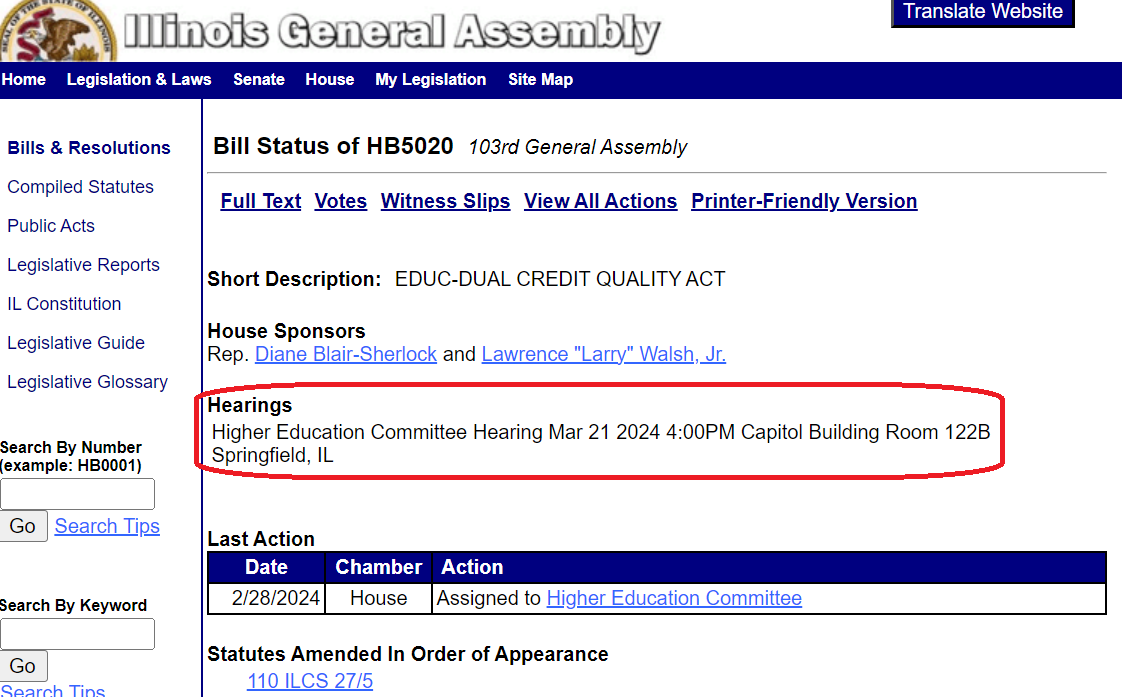
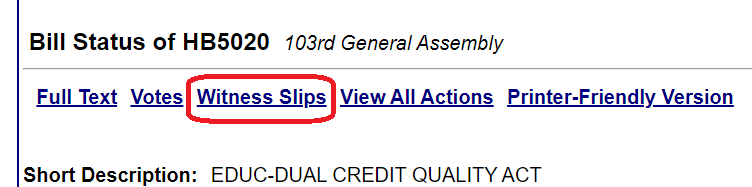
There are a series of steps that a user needs to click through in order to actually create a witness slip. These apply not only to HB5020 but to all bills introduced in the Illinois General Assembly. The first step is to click the “Witness Slips” link near the top of the page.
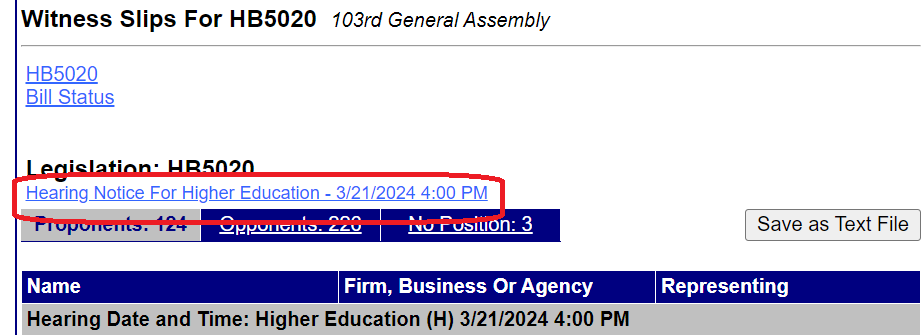
On the next page that loads, you can see who has issued witness slips in support of the bill, in opposition to the bill, and with no position. Near the top of this page, there is a link that you should click on to continue to move through the process to create your own witness slip.
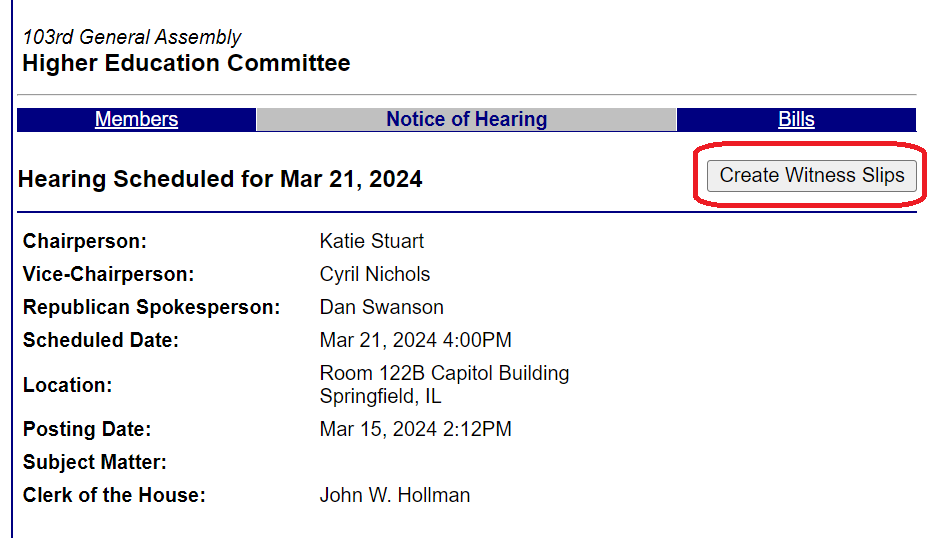
On the next page, click the “Create Witness Slips” button on the right side of the web page as pictured below.
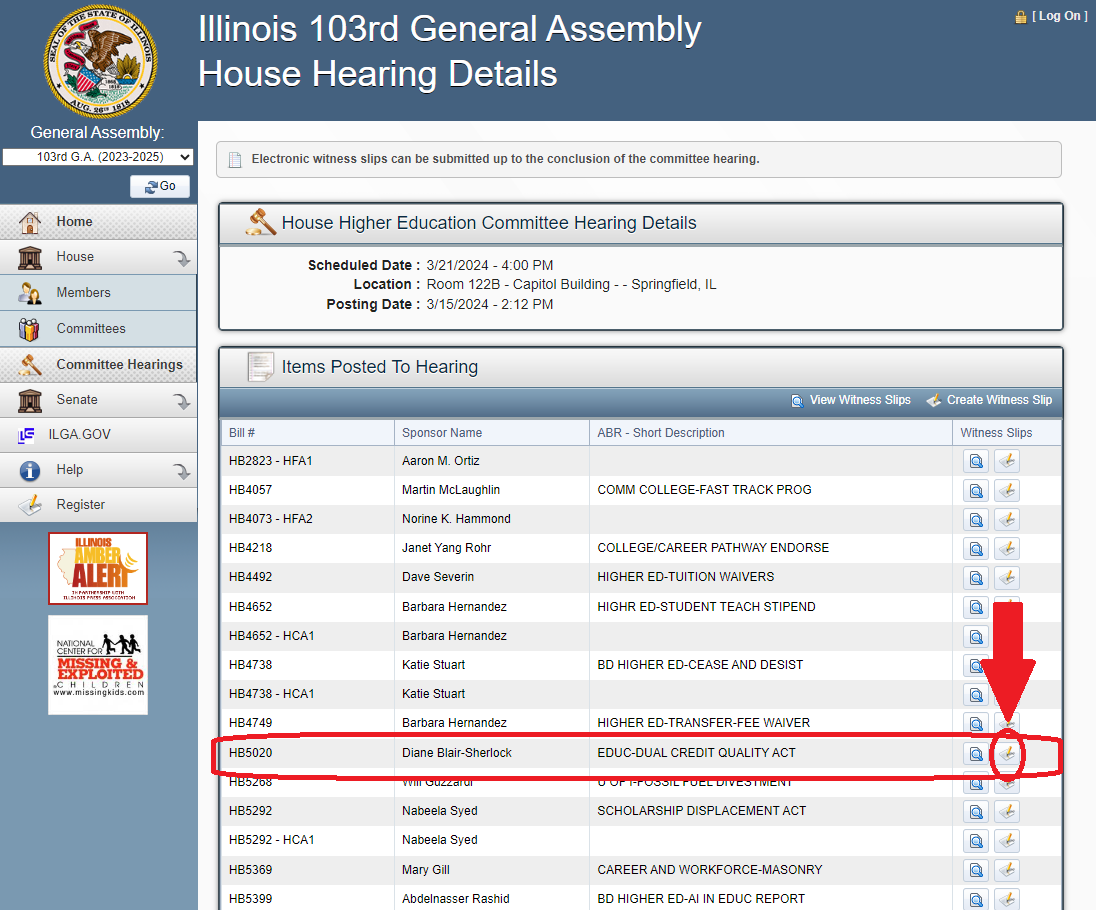
Now, a completely new website will load in your browser with an entirely different appearance. On this page, you need to find the bill on which you want to leave a witness slip. Once you have identified that bill’s row, you will click the icon on the far right of the row to create your own witness slip. (That button is circled in the image below.)
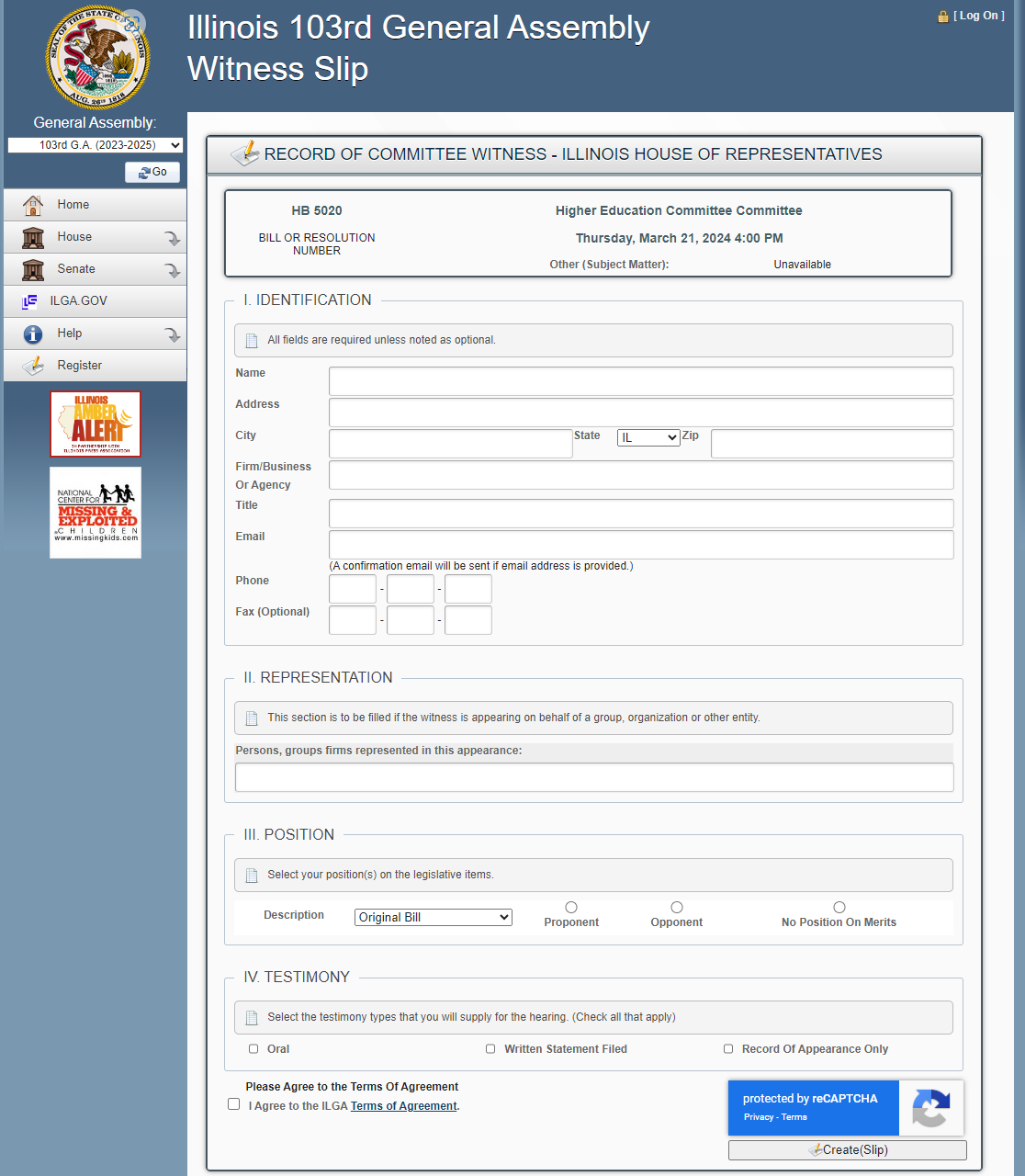
The Witness Slip form will now open. Complete this entire form. Be sure to provide your context and expertise. If you have data, include that data (while, obviously, protecting the privacy of personally identifiable information). Before you can submit, you do need to check the checkbox in the lower left corner in order to agree to the terms of the site before you can submit.
Factsheet Released on Proposed Amendment to the Dual Credit Quality Act
Stand for Children Illinois has released a two-page summary factsheet of House Bill 5020. This document provides information on student enrollment gaps across different demographic groups as well as highlights the pace at which dual credit continues to grow.
More importantly, the factsheet provides a quick summary of the proposed amendment to the Dual Credit Quality Act. This includes:
- Multiple measures for student eligibility and increased communication with families.
- Statewide framework for minimum qualifications to teach (per the new HLC guidelines).
- Guidance on partnering with alternative postsecondary institutions.
The Illinois P-20 Network’s Dual Credit Think Tank will continue to collect feedback from educators across Illinois from both school districts and postsecondary institutions throughout the process.
If you have any questions or comments, please feel free to contact Rodrigo López, Director of P-20 Initiatives (rodrigo.lopez@niu.edu).
March 2024An Overview Webinar of HLC’s Proposed Policy Changes
On September 6, 2023, Rodrigo López, Director of P-20 Initiatives at Northern Illinois University, and Aimee Galvin, Government Affairs Director at Stand for Children Illinois, hosted an informational webinar for educators across Illinois on behalf of the Illinois P-20 Network’s Dual Credit Think Tank.
With attendees from across Illinois representing secondary and postsecondary institutions, Rodrigo and Aimee reviewed the Higher Learning Commission’s (HLC) proposed policy changes to Faculty Qualifications, resulting from the HLC’s Board of Trustees’ first reading of the policy this past summer. The Board is expected to vote on the proposed Faculty Qualifications policy during their upcoming meeting this November.
The webinar provided background context to these proposed policy changes, and the webinar also provided information on the current policy and guidelines (Determining Qualified Faculty Through HLC’s Criteria for Accreditation and Assumed Practices) as noted in the Assumed Practices – CRRT.B.10.020. Aimee from Stand for Children Illinois offered an overview of their organization’s philosophy on dual credit and shared some thoughts on potential implications for both school districts and postsecondary institutions in Illinois, which are included in the Stand for Children Illinois HLC Proposed Rule Change Comment Letter.
Next Steps for Practitioners to Consider (and for Action)
The proposed policy changes and the information shared by the Dual Credit Think Tank present a time-sensitive opportunity for both school districts and postsecondary institutions to engage in a conversation about how these changes may impact their goals and their directions moving forward. For example, the HLC is seeking to adopt Progress toward academic credentials as an alternative to approve instructors to teach college courses. In the context of dual credit, this allows dual credit partnerships to construct a framework to explore the use of Professional Development Plans as a means to be credentialed to teach dual credit courses, similar to what is described in the Dual Credit Quality Act. Additionally, Illinois P-20 Network partners might find value in learning more about implementing a local policy that uses Equivalent Experience to increase dual credit instructors within career and technical education.
Understanding that dual credit partnerships from across Illinois face their own unique challenges, the Dual Credit Think Tank encourages all members to critically analyze the proposed policy changes and participate in the open comment period.
Please note that comments to HLC regarding this proposed policy change remain open through September 18, 2023. Comments can be provided to HLC via email: policycomments@hlcommission.org
The full webinar can be viewed on YouTube or below.
The Higher Learning Commission’s Proposed Policy Changes to Faculty Qualifications
On June 22, the Higher Learning Commission (HLC) Board of Trustees had the first reading of the changes to its Faculty Qualifications policy. The HLC Board is expected to vote on this proposal at its November 2023 meeting following the proposal’s second reading.
Aimee Galvin from Stand for Children Illinois and Rodrigo Lopez from the Illinois P-20 Network will host an informational webinar on the HLC’s proposed policy changes and share comments submitted to the HLC as part of their open comment period. They will also share a range of perspectives on the potential implications as gathered from the field.
The webinar will be hosted on September 6th from 3-4 PM. We invite you to attend by registering using this online Google form.
Please note that comments to HLC regarding this proposed policy change remain open through September 18, 2023. Comments can be provided to HLC via email (policycomments@hlcommission.org).
Please continue reading below for additional background and details about these proposed HLC policy changes.
Background
The HLC is one of the six regional accreditors in the United States. The proposed changes, if approved, apply to all postsecondary education institutions accredited by the Commission in the State of Illinois, along with 18 other states. These changes would revise “the faculty qualification provision in HLC’s Assumed Practices (B.2) to emphasize that an institution must establish and maintain processes for determining that instructors are qualified.”
The proposed policy changes are based on the feedback that the HLC has compiled over the past several years. More recently, the HLC held conversations with leadership from the Midwestern Higher Education Compact (MHEC) and the National Alliance of Concurrent Enrollment Partnerships (NACEP), two of the most critical and knowledgeable organizations on dual credit.
Faculty Qualifications: Proposed Policy Changes
The proposed HLC changes would give postsecondary educational institutions flexibility to establish local procedures that determine qualified faculty based on “the achievement of academic credentials, progress toward academic credentials, equivalent experience, or some combination thereof.”
Furthermore, the HLC has drafted “Institutional Policies and Procedures for Determining Faculty Qualifications Guidelines” to support colleges/universities determined “reasonable” procedures in accordance with the newly proposed changes.
- Achievement of academic credentials – “An instructor possesses an academic degree relevant to the discipline and at least one level above the level they intend to teach.”
- Progress toward academic credentials – “Demonstrable, current, and consistent progress toward the academic credential(s) deemed relevant by the institution for an instructor to be qualified.”
- Equivalent experience* – “Experience commensurate with achievement of academic credentials such that it qualifies an instructor for the instruction (e.g., a minimum threshold of experience; research and/or scholarship; recognized achievement; and/or other activities and factors).” (Experience with classroom instruction as a teacher cannot alone constitute equivalent experience.)
Updated PaCE Framework Webinar
Learn more about the new Middle School and updated High School PaCE Frameworks and give feedback
As required by HB3296, which was signed into law last May by Governor Pritzker and updated the Postsecondary and Workforce Readiness Act, the state educational agencies led by ISAC and including ISBE, ICCB, and IBHE, have released drafts of an updated High School PaCE Framework and a new Middle School PaCE Framework for public comment.
On Monday, March 13 at 9 AM, the Illinois P-20 Network will host a webinar providing an overview of the PaCE Framework, the updates to the High School PaCE Framework, and details regarding the Middle School PaCE Framework. This webinar is free and open to all educators across Illinois, yet it will be specifically geared for the elementary and unit school districts that have not begun to consider the PaCE Framework with the new requirements extending to grades 6-8.
High school districts are encouraged to share this learning and feedback opportunity with their sender elementary school districts. Feedback to the state educational agencies can be provided via this online PaCE Framework feedback form until March 21, 2023.
February 2023Webinar Recap – HLC Proposed Policy Changes
On February 7, 2023, Rodrigo López, Director of P-20 Initiatives at Northern Illinois University, and Aimee Galvin, Government Affairs Director at Stand for Children Illinois, hosted an informational webinar for educators across Illinois on behalf of the Illinois P-20 Network’s Dual Credit Think Tank. With attendees from across Illinois and representing school districts, community colleges, universities, and other professional and interest groups, the proposed policy changes recently communicated by the Higher Learning Commission (HLC) were shared. While the HLC proposed policy changes were the primary focus of the interview, Rodrigo and Aimee also reviewed the recent amendments to the Illinois Dual Credit Quality Act and shared the proposed rule changes to the ICCB System Rules Manual that pertain to dual credit (Section 1501.313).
View the webinar below or on the Illinois P-20 Network’s YouTube channel. Continue reading below the video for next steps.
Action Items
- If you are an HLC member institution, please consider submitting feedback on these proposed changes at this time. Learn more about HLC’s proposed revisions. Feedback by member institutions is due to HLC by February 15, 2023.
- Participate in the Dual Credit Think Tank’s next major task – Collecting and publishing best practices for reviewing the credentials and experiences of high school teachers beyond their earned academic credentials.
For more information on the Dual Credit Think Tank or to get involved, please contact Rodrigo López at rodrigo.lopez@niu.edu
HLC Call for Feedback
Proposed Policy Changes to Assumed Practices (CRRT.B.10.020)
The Higher Learning Commission (HLC) has announced its proposed policy changes to Assumed Practices – CRRT.B.10.020. As one of six regional accreditors in the United States, these proposed changes, if approved by the Board, will help to “eliminate any restrictive impact of HLC’s requirements on student access to dual credit programs in underserved or rural areas.” Degree-granting postsecondary educational institutions in the State of Illinois, along with those located in the other 18 states, may be in a position to benefit and modify existing practices specific to the review and approval of faculty qualifications.
HLC member institutions have been requested to share feedback on these proposed changes before its formal comment process is initiated. Learn more about HLC’s proposed revisions. Feedback by member institutions is due by February 15, 2023.
The Illinois P-20 Network in collaboration with the Illinois Alliance of Concurrent Enrollment Partnerships (ILACEP) has worked with a diverse group of secondary and postsecondary educators to increase knowledge and support dual credit opportunities. As dual credit has become a critical component of schools’ early college credit programs, the Dual Credit Think Tank has focused its efforts on advocating for policies and practices that lead to an increase in the number of high school instructors teaching dual credit courses.
In June 2022, the HLC’s Board of Trustees extended the deadline for enforcement of faculty qualifications requirements in the context of dual credit education from September 1, 2023, to September 1, 2025. Institutions not in compliance with the requirements of Assumed Practice B.2.a, not only have an additional two years to get their dual credit offerings into compliance but may also have additional options with the approval of the policy changes.
Although recent amendments to the Dual Credit Quality Act have continued to address the challenges faced by dual credit programs to have more high school instructors credentialed to teach dual credit courses, revisions to HLC’s policies would make clear “that an institution can deem its faculty qualified on the basis of academic credentials, equivalent experience or some combination thereof” and that it may also “take into account substantial progress toward academic credentials in addition to achievement of such credentials” to create “parity between teaching assistants and dual credit instructors who are similarly situated in this regard.”
The Illinois P-20 Network Dual Credit Think Tank will be hosting an informational webinar on the HLC proposed policy changes to Assumed Practices – CRRT.B.10.020 on February 7, 2023, at 2 PM (CT) – Register today!
January 2023Provide Feedback on CTE Standards to ISBE
ISBE wants your feedback on potential Illinois Career and Technical Education (CTE) Standards. All Illinois educators are encouraged to watch this recorded 15-minute webinar then complete this feedback survey. Links to all of the relevant elements of the webinar are below:
Draft Career Pathway Standards Documents
- Agriculture, Food, and Natural Resources
- Arts and Communications
- Finance and Business Services
- Health Sciences and Technology
- Human and Public Services
- Information Technology
- Manufacturing, Engineering, Technology, and Trades
The individual feedback survey is available to all educators in Illinois through November 6, 2022.
October 2022ISBE CTE Standards – Teacher Feedback Wanted
This summer, CTE educators explored the data from the CTE Industry Feedback Tour and considered it in light of identified best practices nationally in CTE in order to make recommendations regarding our need for CTE standards and supporting professional development in Illinois.
An additional opportunity for educators to provide input will take place in the format of a webinar focused on gathering feedback on options for adopting CTE Standards within the State of Illinois. Sessions will be held from 7.30 until 9 AM and 3.30 until 5 PM on September 29, 2022. Participation is open to all educators, teachers and administrators, who teach or support Career & Technical Education programs in Illinois.
The goal of this work will be to provided teachers, schools, and school districts with the tools necessary to ensure that there are high-quality and equitable CTE opportunities for all students across Illinois and for the ISBE CTE team and its partners to best support educators in meeting those goals.
Sessions will take place via Zoom and are expected to last no more than 60 minutes. Zoom links will be sent to those registered the day before each session.
If you would like to attend both sessions, we do ask that you complete the form separately for each session.
September 2022Dual Credit Think Tank Policy Brief Released
Strategies to Support Teachers in Credentialing for Dual Credit
In January 2022, the Illinois P-20 Network’s Dual Credit Think Tank launched a state-wide survey to gather examples from school districts of contract language, policies, procedures, and practices that support dual credit teacher licensure. Particularly in the face of the teacher shortage, school districts must identify new strategies to address these credentialing issues. While the recent amendment to the Illinois Dual Credit Quality Act includes an extension for teachers to secure a professional development plan which allows them to start teaching dual credit courses while they finish the minimum teaching qualifications as prescribed by the Higher Learning Commission, school districts continue to face significant challenges in supporting the necessary number of teachers in becoming credentialed to teach dual credit classes.
Additional support and resources are necessary to increase the number of teachers with dual credit credentials. Understanding school districts’ need for guidance on how they can leverage existing mechanisms, the Dual Credit Think Tank has published Strategies to Support Dual Credit Teacher Credentialing, a policy brief for educators and advocates that highlights best practices for schools to adopt in their aim to further support teachers’ journey towards meeting the minimum qualifications to teach dual credit courses. Specifically, the brief offers recommendations, based on the responses to the survey from earlier this year, on how school districts can collaborate with teachers via their collective bargaining agreements to implement financial assistance and incentives.
August 2022Dual Credit and Weighted Grades
As a result of conversations with a number of high school administrators in different school districts who wanted to understand the landscape of how school districts are weighting grades for dual credit coursework within their high school grade point average systems, the Dual Credit Think Tank conducted a survey asking school districts the question of if (and, if so, how) dual credit courses are weighted in their school district.
Based on each district’s answer to this single question and knowing what district each answer was coming from, deeper analysis was also able to take place based on a number of other demographic factors regarding students and teachers in each school district. The results of this survey, and policy recommendations from the Dual Credit Think Tank are contained in this slide deck, which was presented as part of a Dual Credit Think Tank Update webinar to ILACEP in March 2022. In short, the Dual Credit Think Tank recommends:
March 2022If you have weighted classes, ALL early college credit coursework should be weighted the same as advanced/accelerated classes.
Illinois P-20 Network Dual Credit Think Tank, March 2022
ISBE to host meetings about CTE Standards with professionals from across careers
Educators, please share with your business and industry and community partners and encourage them to join us!
Among educational leaders at all levels, the advancement of Career and Technical Education (CTE) is a high priority for students in middle school, high school, and in the full range of postsecondary institutions. As part of these efforts, the Illinois State Board of Education (ISBE) is developing Illinois’ first set of statewide student learning standards for CTE instruction. The CTE standards will provide broad targets on which school districts can develop their local CTE curriculum and which will provide a focus to teachers in creating student learning opportunities.
ISBE is planning regional meetings (north, central, and south) to gather feedback from professionals across a wide range of industries on the knowledge and skills that students need to be successful as they move into our current and future workplaces.
- April 15 – 9 AM – Mt. Vernon Airport
- April 18 – 1 PM – Heartland Community College
- April 19 – 10.30 AM – Elgin Community College
- April 22 – 9 AM – Online via Zoom
(Zoom information will be sent to registered participants on April 21.)
Registration is free to these events, which are open to individuals from across all industries and professions. Please click here to register.
The results of these regional meetings will be used by educators from across Illinois in June to engage in similar activities around the CTE Standards. In partnership with ISBE, we hope to have a large turnout to support these efforts and ensure that our educational outcomes are on-target for our students, so please share this information with colleagues.
March 20222 Important Dual Credit Think Tank Surveys
The Illinois P-20 Network’s Dual Credit Think Tank is focused on collaborating with school districts and postsecondary to help continue refining practices to ensure that students across Illinois can access high-quality dual credit and dual enrollment offerings.
1-Question Survey about Dual Credit Classes & Weighted GPA
The Dual Credit Think Tank is also seeking information on this 1-question survey regarding how dual credit classes are weighted in GPA calculations in school districts. Please pass this 1-question survey on dual credit and GPA weighting on to as many school districts as possible – It should take less than 30 seconds to complete, and we will share the results through both ILACEP and the Illinois P-20 Network.
Survey about Contract Language, Policies, and Practices to Support Dual Credit Teacher Licensure
The Illinois P-20 Network’s Dual Credit Think Tank identified teacher licensure as the most important of a number of significant areas for additional work to further enhance and expand dual credit and dual enrollment early college offerings in Illinois high schools. A number of school districts have inquired about example collective bargaining contract language, school district policies, and school district practices (including administrative procedures) that are in place in districts across Illinois that are designed to support and encourage teachers with completing the additional requirements to teach dual credit courses. The Illinois P-20 Network Dual Credit Think Tank has put together this survey to gather examples of contract language, policies, and practices that support dual credit teacher licensure.
If you are able to offer any examples, those will be most welcome to other school districts!
January 2022Information about applying for Career Pathway Endorsements for the 2021-2022 school year!
The ISBE College & Career Pathways Endorsement website has been updated and includes a variety of resources that will assist those with their plans to implement/offer pathway endorsements to students. Included among these resources are an updated ISBE College and Career Pathway Endorsement Framework and the ISBE Pathway Endorsement Infographic.
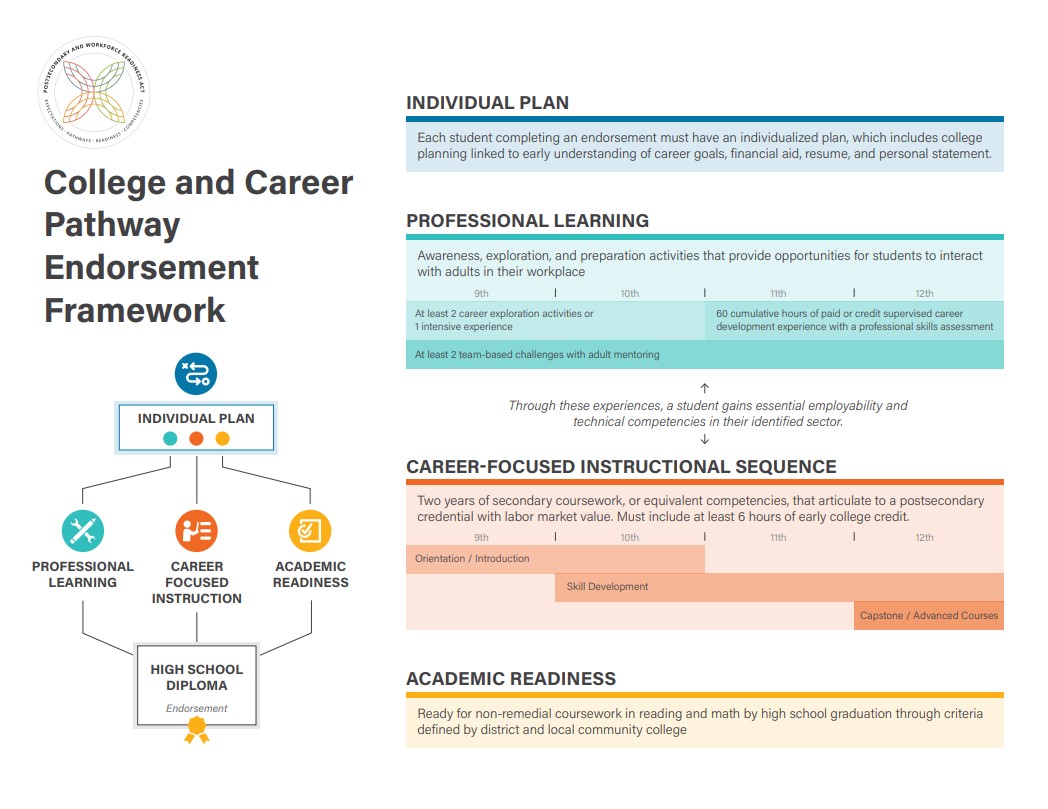
Should schools wish to begin building plans within the online web tool, they would need to contact Heather Strom at the Illinois State Board of Education so that she can provide the school district with a link to the web tool (Email: pathwayendorsements@isbe.net). Please note that first, the school district would want to gather the necessary information using the Excel spreadsheet. This will make data entry easier and more accurate.
Also, if you are planning on issuing any Career Pathway Endorsements for FY21, you will need to complete the FY21 application and district projections that are found on the ISBE CCPE website.
In corresponding about this important announcement, Heather said, “I’m very excited to be working with schools and applaud their efforts to offer pathway endorsements to their students!” Obviously, the Illinois P-20 Network echoes this sentiment. If you have questions, please reach out to Heather at the email address included above, but please feel free to contact us as well as the team at Education Systems Center as we can continue to work collaboratively to support both ISBE and all of you working in school districts.
April 2021Dual Credit Think Tank – Update
We are pleased to announce that, in collaboration with ILACEP, we are restarting the Dual Credit Think Tank. We are currently working to identify meeting dates and times, and we will be emailing specific information to everyone who was involved with the Dual Credit Think Tank last spring as well as those who have already reached out to express interest in participating in the Dual Credit Think Tank moving forward.
If you or someone in your organization is interested in participating in the Dual Credit Think Tank, please email us at: p20network@niu.edu
Continue reading below to learn more about the next steps for the Illinois P-20 Network Dual Credit Think Tank.
Plans for the Dual Credit Think Tank moving forward over the remainder of 2021 include:
- Focus on one sub-committee at a time – The Teacher Credentialing Sub-Committee remains critical and is identified as a key area in the ILACEP Illinois Dual Credit Report under the header, Instructor Capacity. This group will begin meeting in the coming weeks and will meet monthly through June. Then, beginning during the summer, attention will shift to the Communications Sub-Committee, which will meet through much of the fall. At the moment, we will hold off on restarting the Finance Sub-Committee, but if conversations in either Springfield or Washington, D.C. necessitate that Sub-Committees work, we will quickly spring into action and potentially pause the work of the other Sub-Committees.
- Co-Facilitators – As we re-launch each Sub-Committee, we will seek two co-facilitators within each group to partner with Jason Klein in leading the Sub-Committee.
- Consistent Meeting Times – While this is always difficult and complex with the busy schedules of educational leaders across institutions, as each Sub-Committee re-starts, it will lay out a schedule of monthly meetings for the anticipated period of its work.
Transitional Math ISBE SIS & Portability Code Information
The Illinois P-20 Network is pleased to share the following information on behalf of the Illinois State Board of Education and the Illinois Community College Board.
In order for students to receive the full benefits of Transitional Math, the correct Illinois State Board of Education Student Information System (SIS) course code and Illinois portability codes must be utilized. The Transitional Math SIS codes can be found below and are also within the provided portability document templates as well as the policies document, which can be found on the Illinois Transitional Math website.
Please note that there are different ISBE SIS course codes and portability codes for each of the distinct Transitional Math courses that are offered.
As always, school districts should ensure that they are uploading the correct course codes in ISBE SIS to accurately report students’ course completions.
Additionally, portability codes should be placed on the high school transcripts of students who have successfully completed a Transitional Math course. Community Colleges across Illinois utilize the portability code from the high school transcript to identify students who should be correctly placed in college credit-bearing mathematics courses.
- STEM Pathway
ISBE SIS Code – 02055A001
Portability Code – TM001 - Quantitative Literacy and Statistics Pathway
ISBE SIS Code – 02201A001
Portability Code – TM002 - Tech Pathway
ISBE SIS Code – 02153A001
Portability Code – TM003
Implementation of Transitional Math is now entering the second semester of the second year of implementation. We currently have over 200 approved courses across the state of Illinois. We are excited to see the progress that school districts and students are making with the implementation of Transitional Math. Approved courses can be found on the Illinois Transitional Math website.
As a reminder, the next opportunity for Transitional Math portability submission is due on March 1, 2021, and those submissions will be considered at the Spring Portability Panel meeting on April 14, 2021.
If you have any questions regarding transitional courses, please e-mail TRInstruction@isbe.net.
January 2021Learning – remote & in-person across the P-20 Network
As the 2020-2021 school year begins in never-seen-before fashion, school districts and postsecondary institutions are each determining the best ways to balance the needs of keeping students and staff members safe, meeting the demands of their stakeholders, and supporting students with learning and teachers and faculty with teaching.
Over the past year, as part of the NIU P-20 Research & Data Collaborative, Illinois P-20 Network staff have been deeply involved in a number of statewide research projects on topics ranging from early childhood education through postsecondary student performance. In an effort to best serve the Illinois P-20 Network, through conversations with leaders of P-20 Network partners, it has become increasingly clear that one way in which the P-20 Network can support its partners is by collecting and providing access to real-time data. To this end, P-20 Network staff have collected data from partners’ websites on the current status of their remote versus in-person learning plans for the start of the 2020-2021 school year. While the Illinois State Board of Education has also created a similar tool for analyzing remote versus in-person learning, it only includes data from about 75% of the state’s school districts that responded to ISBE’s survey request.
This data below is provided separately at each level – elementary school, middle school, high school, and postsecondary. In conducting the data collection and analysis, the P-20 Network team quickly understood that many school districts are approaching their remote and hybrid learning models in complex ways, and this led to the presentation of data in this way.
Below, there are 4 slides of data with a chart and map at each level that you can click through:
- Postsecondary Institutions
- High Schools
- Middle Schools
- Elementary Schools
Postsecondary Institutions
High Schools
Middle Schools
Elementary Schools
If the data for your organization is inaccurate, please let us know by emailing the Illinois P-20 Network.
Over the coming weeks, we will be seeking out additional data, including trying to collect the cost of COVID-19 thus far on each of your institutions, and we will be refining and improving these type of data visualizations moving forward. We look forward to bringing you more useful data in ever-more usable formats in order to best support organizations across the Illinois P-20 Network.
August 2020The P-20 Network – Who we are collectively – June 2020
At the historic and unusual end of the 2019-2020 academic year, the P-20 Network decided to collect a small amount of demographic data and analyze the make-up of the Network based on who its students are as reported publicly via the Illinois Report Card and Illinois Postsecondary Profiles websites. This data is based on the numbers reported on those websites on June 30, 2020, which, to a large degree, is data from the previous school year (a year old). Nevertheless, it paints a relatively accurate picture of who makes up the P-20 Network. For this analysis, only data from school districts and postsecondary institutions from across the Network was studied as including the state agencies or other statewide organizations would naturally include all students and organizations across Illinois.
Overall, the P-20 Network currently includes organizations that serve over 700,000 students, and approximately half of them are served in school districts and half of them are served in postsecondary institutions.
Elementary & Secondary Students
Across the school districts that are engaged with the P-20 Network, there are 366,810 students. In general, the demographics of the P-20 Network mirror the State of Illinois with a few key differences.
| Student Demographic | P-20 Network (%) | State (%) |
| Low Income | 38 | 49 |
| Students with IEPs | 15 | 16 |
| Homeless Students | 2 | 2 |
| Students learning English | 13 | 12 |
| White Students | 49.4 | 47.6 |
| Black Students | 8.4 | 16.7 |
| Hispanic Students | 28.4 | 26.4 |
| Asian Students | 9.4 | 5.1 |
| American Indian Students | 0.3 | 0.3 |
| Pacific Islander Students | 0.1 | 0.1 |
| Students of 2 or more races | 4.0 | 3.8 |
The school districts that participate in the P-20 Network have an overall lower percentage of low income students (38%) than Illinois does statewide (49%) and a lower percentage of students whose families identify as Black (8.4%) than does Illinois (16.7%). There is also a higher percentage of students whose families identify as Asian across the P-20 Network school districts (9.4%) than there is across the entire state (5.1%). Not represented by this data is the fact that the school districts that currently make up the P-20 Network also represent a wide variety of communities, from smaller (in population), rural farming communities to urban centers to a wide range of suburban communities featuring many different types of housing and commercial areas. The range of careers that make up the communities represented across the P-20 Network is arguably as diverse as anywhere in the United States.
Despite these differences, the general diversity of students across Illinois is represented by the school districts across the P-20 Network, and regardless of comparisons, the students being served across these school districts represent a wide variety of backgrounds and experiences.
Postsecondary Students
As a result of the efforts of the Illinois Community College Board, the Illinois Board of Higher Education, and the Illinois Student Assistance Commission, the Illinois Postsecondary Profiles website offers a wealth of data about students in higher education in Illinois. This data is not aggregated statewide like it is in the Illinois Report Card, and there is not data included about how old students are or what their pathways to their current postsecondary experiences are. (For example, the question how many current community college students already have a Bachelor’s Degree? is not answered by this data.) Nevertheless, there are some important data points we can begin to track across the P-20 Network.
| Student Demographic | P-20 Network (%) |
| Full-Time Students | 41 |
| Part-Time Students | 59 |
| White Students | 48 |
| Black Students | 11 |
| Hispanic Students | 25 |
| Asian Students | 7 |
From even this brief data set, there are a number of important points for analysis. First, the percentages of full-time versus part-time students has significant implications for instruction, schooling, and supports. Most of the postsecondary institutions in the P-20 Network are community colleges (20 of the 25 postsecondary institutions), and the high number of part-time students is not new or uncommon in community colleges. Nevertheless, it is important information for programming and supports and ensuring advancement and degree completion. With regards to the race/ethnicity data points, the enrollment of postsecondary students across P-20 Network institutions closely reflects the demographic characteristics of the population of elementary and secondary students with Black students being underrepresented in postsecondary institutions in comparison to the percentage of the current K-12 student population statewide and with Asian students being represented at a higher percentage in postsecondary institutions than they are in the current K-12 student population statewide.
Overall, the P-20 Network is very diverse, and educational successes across the P-20 Network are successes that can likely be replicated across Illinois, the United States, and beyond.
Thank you to P-20 Network Graduate Research Assistant Sadia Qamar for the data collection and methodology work done that served as the foundation for this analysis.
June 2020Transitional English – Learn more and provide feedback
Over the course of the 2018-2019 school year, in collaboration with the Illinois State Board of Education, the Illinois Community College Board, and the Illinois Board of Higher Education, Education Systems Center led a committee of educators from school districts and postsecondary institutions in the development of the draft Course Parameters and Competencies for Transitional English. During this same period, the Illinois Community College Board awarded grants to support community colleges and school districts in beginning to develop and launch their Transitional English programs locally that would based their work on this statewide framework. The ICCB Transitional English Grant awardees represent a variety of institutions, geographic regions, and demographics throughout Illinois.
On June 2, 2020, Education Systems Center, the state agencies, and representatives of the Competency Development Group presented a statewide Transitional English webinar to provide background and explanation regarding Transitional English.
Educators and the public can provide feedback on the draft framework using this Transitional English Public Comment Survey through July 31, 2020.
The image below provides an outline of the process of moving from where it is today to full implementation.
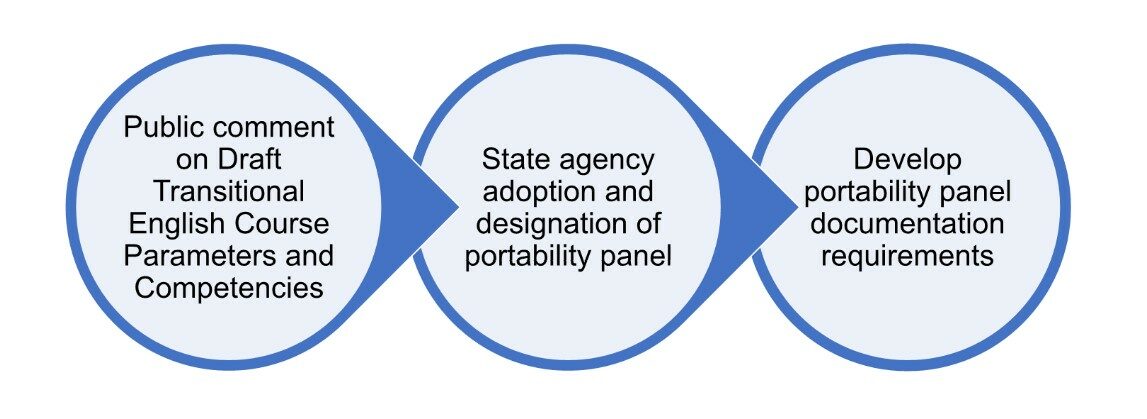
At the time of the publication, the State of Illinois is in the left-most circle. Based on the feedback, there may be adjustments to the draft framework. Then, during Fall 2020, it is anticipated that the state agencies will review the course parameters and competencies and then adopt them. At that point, the work will shift to implementing the statewide portability panel in order to ensure that all students who are successful in Transitional English can be placed in the appropriate college English class across Illinois.
For more information, visit the Illinois Community College Board’s official Transitional English website.
June 2020Transitional English – Public Comment opens June 1st
Transitional English info is available for review now, and there are two upcoming webinars in which you can participate to learn more and ask questions!
Throughout the 2019-2020 school year, a statewide committee of educators representing school districts, community colleges, universities and state agencies came together to examine research and best practices and to develop competencies and course parameters for Transitional English to be offered to high school seniors throughout Illinois. Recently, the committee’s work was published in this draft Statewide Transitional English Course Parameters and Competencies document. Public comments will be collected between June 1, 2020 through July 31, 2020.
Information to login to each of the following webinars is being sent out to P-20 Network Newsletter subscribers on Friday, May 29th. If you do not currently receive the P-20 Network Newsletter, complete this short P-20 Network Newsletter Subscription Form before May 29th. After May 29th, for more information on logging in to these webinars, please contact Brooke Simon at the P-20 Network.
Introductory Webinar
On June 2, 2020, at 2.00 PM, Education Systems Center will be hosting a webinar to provide important background information regarding Transitional English.
Follow-Up Webinar – Brief Overview and Question & Answer Time
On June 9, 2020, at 2.30 PM, the P-20 Network and Education Systems Center will be jointly hosting a webinar to answer questions from practitioners about the proposed Transitional English Course Parameters and Competencies. Login information for the webinar is listed below. Organizations are also encouraged to submit questions about Transitional English ahead of time online.
May 2020P-20 Research & Data Collaborative – Ready to help your organization with research and data
The P-20 Network is a proud partner with key departments and academic units at Northern Illinois University in the NIU P-20 Research & Data Collaborative.
The NIU P-20 Research & Data Collaborative empowers your progress with data and research initiatives within your organizations that are crucial to making informed decisions in this critical time. Whether generating, understanding, managing or engaging with data and research, the Collaborative has project experience and staff with that expertise. Our current data and research portfolio includes projects with:
- local school districts
- local government agencies
- statewide policy
- workforce development
- early childhood programming
Please reach out to the P-20 Research & Data Collaborative or the P-20 Network to see how we can support your organization with meeting specific data and research needs.
- Alan Clemens, Director of Illinois Interactive Report Cards at Northern Illinois University
- Jason Klein, Director of P-20 Initiatives
Dual Credit and Advanced Placement while Learning at Home
UPDATED – 27 March 2020 – Additional guidance about dual credit classes from ISBE, ICCB, and IBHE has been released and is available online here. Everything in this new guidance aligns with the “Dual Credit” section below, and it offers additional specific suggestions for ensuring students can access online coursework as well as for individual plans for students to complete the coursework and for late withdrawals if necessary.
With all Illinois schools being closed for on-site instruction due to Governor Pritzker’s Executive Orders (Executive Order 2020-10), school districts and community colleges have made a tremendous shift to distance/remote learning on a never-seen-before scale in a a matter of days. While there is a great deal of flexibility that may be on offer in a variety of classes, Dual Credit and Advanced Placement courses present unique challenges–namely, that their successful completion will also designate to other (future) institutions that the student has mastered specific skills and concepts.
Advanced Placement Changes for Spring 2020
On Friday, March 20, 2020, The College Board, the not-for-profit organization that administers the Advanced Placement (AP) program and creates, implements, and scores the AP Tests, made announcements about its plans to modify AP Testing for Spring 2020. Key elements of this decision include:
- 45-minute, one-question free response tests in place of multiple choice plus free response tests that take hours to complete
- Limited curricular scope that should include only what was already covered
- Opportunity to cancel participation free-of-charge if students wish
- Online testing as well as the option of photographing and sending a handwritten response (with support from College Board to help ensure access to both devices and the Internet for students who do not currently have both at home)
Additionally, beginning on March 25th, online support led by teachers will be available for students from The College Board via the AP YouTube Channel. A full schedule and resources can be found here under the header Free AP Review Classes.
Dual Credit Classes
In keeping with the spirit of Illinois’ Dual Credit Quality Act and the Model Partnership Agreement, it is necessary for the community college or university offering the postsecondary credit and the school district that is offering and teaching the dual credit course to agree upon the standards and criteria necessary to continue with the awarding of postsecondary credit to students.
With school districts, community colleges, and four-year universities all moving to online and remote learning environments, there is a common basis for these discussions and decisions. In gathering feedback from school districts and community colleges throughout the P-20 Network and who are serving as leaders on these issues through the P-20 Network’s Dual Credit Think Tank, the following steps are suggested between school districts and postsecondary institutions as best practices at this time:
- Discuss – Be sure to open the lines of communications about what is expected with regards to curriculum, how it is delivered instructionally, and how the skills and concepts will be assessed.
- Make similar adjustments – As universities and colleges make adjustments to curriculum with the move to learning at home, those changes should be communicated to school districts, and it is reasonable to expect the school districts to make the same adjustments rather than simply expecting them to continue on as originally planned. It is critical that the course objectives are clear and consistent across school districts and the higher education institution, and that all students are being supported with meeting those objectives.
- Trust school districts – Just as face-to-face courses in higher education have moved online, school districts will need to do the same with their dual credit courses like all of their classes. Additionally, teachers in school district settings are certified by the state as a result of their strong background in pedagogical coursework and their student teaching experience, so they should be as well-prepared as faculty in postsecondary institutions to make these adjustments.
The Illinois State Board of Education (ISBE) and the Illinois Community College Board (ICCB), like other state agencies in Illinois and around the United States, are working through these policy challenges and seeking to provide clear guidance as quickly as possible. If guidance specific to Dual Credit is issued by either or both of these agencies, that should be followed. (It will very likely be issued by both jointly.) At the moment, ISBE has told school districts in its most recent March 23rd Guidance Document:
March 2020Please work with your community college partners to ensure that students will not be penalized by these circumstances. ISBE and ICCB are working on additional coordinated guidance.
Survey – What support do you need with Perkins V?
The Illinois State Board of Education (ISBE) and the Illinois Community College Board (ICCB) jointly implement Perkins V and they continue to provide resources for school districts, community colleges, and EFEs to move through the Perkins Grant process successfully. The following websites include resources and support documentation from these state agencies:
Based on feedback from school districts and community colleges, Education Systems Center, the Center for Governmental Studies, and the P-20 Network, all based out of Northern Illinois University, are seeking to determine if there are additional needs related to the Perkins V processes, and if so, how our organizations may be able to assist. This short survey is designed to provide that feedback to know what needs may exist that require additional support.
January 2020Elements of a Team-Based Challenge
A Career Pathway Endorsement Team-Based Challenge is a self-contained exercise that may vary in length and structure ranging from an individual activity to an instructional unit.
A Team-Based Challenge should require students to utilize and demonstrate competency with work-based knowledge and skills as they work to solve an authentic work-based problem as members of a collaborative team.
Career Pathway Endorsement Team-Based Challenges should include the following features:
- Challenges seek solutions to authentic problems that are identified from and/or in collaboration with industry partners, are regionally relevant and globally connected, and result in a real solution that can be applied and implemented in the “real world”. As part of or in addition to the solution/product, students must complete a presentation of their solution and its application to an authentic audience.
- Students work in collaborative groups to solve the problem.
- Students are supported by an expert mentor from the field. If possible, experts should also be present for student presentations at the culmination of the Team-Based Challenge.
- Challenges require students to demonstrate key technical, employability, and entrepreneurial competencies. Successful demonstration of the competencies through a Team-Based Challenge is typically represented through a rubric and/or another form of authentic assessment.
Career Pathway Endorsement Team-Based Challenges are also a strong vehicle for providing opportunities for new partners with school districts. Since Challenges are shorter in duration and do not require significant commitments of time or the need to host students on-site (and the ensuing policy challenges that may come with that), Team-Based Challenges provide a “lighter” way for new partners to work alongside the school district and to have their employees engage with students as experts. With the proliferation of advanced communications technologies in school classrooms, such interactions may be in-person either in school or at the partner’s site through a research trip or online.
A Career Pathway Endorsement Team-Based Challenge can take place within a course that is part of the identified sequence for a particular College & Career Pathway. Challenges can also take place as part of a co-curricular activity.
November 2019Illinois Report Card Launches with new data
The Illinois Report Card has been updated and released with its annual refresh of new data and, in this year’s case, some additional data. The Illinois Report Card provides schools and other stakeholders a wide range of data to provide insight into trends in and across schools. The Illinois Report Card is overseen by the Illinois State Board of Education and implemented by the Illinois Interactive Report Cards Office at Northern Illinois University. Each year, as required by law, the Illinois Report Card is released with data from the previous school year at the end of October.
This year, the major new data element includes site-based expenditure data, which was reported by school districts for each school to the State for the first time based on the requirements of the federal Every Student Succeeds Act (ESSA).
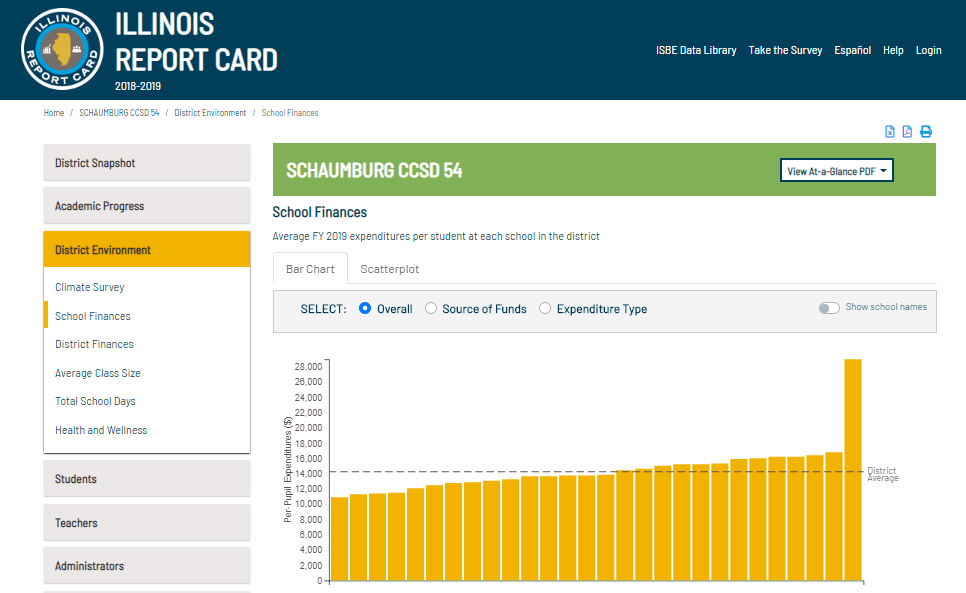
This data shows the overall amount spent by school, and this has garnered widespread reporting from media outlets throughout Illinois; This article from the Daily Herald is just one example.
In addition to the inclusion of the site-based expenditure data, there is a whole range of additional changes to the website from the addition of growth data on the Illinois Assessment of Readiness (IAR) to new fields that can be used to disaggregate data to an updated color scheme. A full list of updates can be found here in the 2019 Illinois Report Card Release Notes, which are also published on the Illinois Report Card homepage.
October 2019